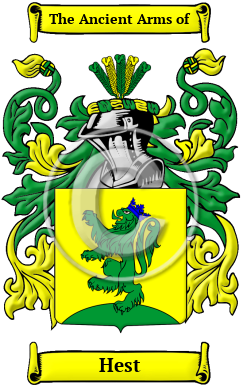
| ![Show Contents]() Hest History, Family Crest & Coats of Arms Hest History, Family Crest & Coats of Arms
- Origins Available:
Scotland
Etymology of HestWhat does the name Hest mean? The ancient Strathclyde Briton name Hest is derived from "the name of an ancestor, 'the son of Anastasia,' from the nickname Anstie, abbreviated to Astie." 1 Some sources note the Hastie variant could have been a nickname for someone who was "hasty, impatient." 2 3 4 Early Origins of the Hest familyThe surname Hest was first found in Lanarkshire (Gaelic: Siorrachd Lannraig) a former county in the central Strathclyde region of Scotland, now divided into the Council Areas of North Lanarkshire, South Lanarkshire, and the City of Glasgow. "Robert Hasty and John Hasty were tenants of Herthornhill in 1376, Thom Hasti witnessed an instrument of sasine dated 1478, and John Haisty was witness to another instrument of sasine in 1525. " 5 Further to the south, the surname was typically found without the "H" prefix as the Hundredorum Rolls of 1273 listed: Adam Asty, Kent; and John Asty, Norfolk. 1 Norfolk had some early entries for the name too: Thomas Asty, Norfolk, 1374; and Robert Asty, rector of West Herling, Norfolk, 1410. 6 Early History of the Hest familyThis web page shows only a small excerpt of our Hest research. Another 130 words (9 lines of text) covering the years 1523, 1543, 1556, 1567, 1595, 1626, 1672, 1730 and 1800 are included under the topic Early Hest History in all our PDF Extended History products and printed products wherever possible. Hest Spelling VariationsScribes in Medieval Scotland spelled names by sound rather than any set of rules, so an enormous number of spelling variations exist in names of that era. Hest has been spelled Hastie, Hasty, Asty and others. Early Notables of the Hest familyAnother 33 words (2 lines of text) are included under the topic Early Hest Notables in all our PDF Extended History products and printed products wherever possible.
| Hest migration to the United States | + |
The number of Strathclyde Clan families sailing for North America increased steadily as the persecution continued. In the colonies, they could find not only freedom from the iron hand of the English government, but land to settle on. The American War of Independence allowed many of these settlers to prove their independence, while some chose to go to Canada as United Empire Loyalists. Scots played essential roles in the forging of both great nations. Among them:
Hest Settlers in United States in the 18th Century- Michael Hest, who arrived in Pennsylvania in 1728 7
- Joh Peter Hest, who landed in America in 1750 7
- Bardsley, C.W, A Dictionary of English and Welsh Surnames: With Special American Instances. Wiltshire: Heraldry Today, 1901. Print. (ISBN 0-900455-44-6)
- Harrison, Henry, Surnames of the United Kingdom: A Concise Etymological Dictionary Baltimore: Geneological Publishing Company, 2013. Print
- Smith, Eldson Coles, New Dictionary of American Family Names New York: Harper & Row, 1956. Print
- Lower, Mark Anthony, Patronymica Britannica, A Dictionary of Family Names of the United Kingdom. London: John Russel Smith, 1860. Print.
- Black, George F., The Surnames of Scotland Their Origin, Meaning and History. New York: New York Public Library, 1946. Print. (ISBN 0-87104-172-3)
- Rye, Walter, A History of Norfolk. London: Elliot Stock, 62, Paternoster Row, 1885. Print
- Filby, P. William, Meyer, Mary K., Passenger and immigration lists index : a guide to published arrival records of about 500,000 passengers who came to the United States and Canada in the seventeenth, eighteenth, and nineteenth centuries. 1982-1985 Cumulated Supplements in Four Volumes Detroit, Mich. : Gale Research Co., 1985, Print (ISBN 0-8103-1795-8)
 |