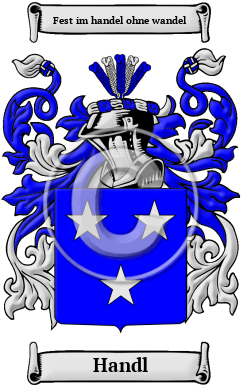
| ![Show Contents]() Handl History, Family Crest & Coats of Arms Handl History, Family Crest & Coats of Arms
- Origins Available:
Germany
Etymology of HandlWhat does the name Handl mean? German surnames developed at a time when most of the German provinces were states of the Holy Roman Empire. At first people used only a single name, but as the population grew and people began to travel, they began to find it necessary to take on an additional name to differentiate themselves. Fairly general principles guided the development of hereditary surnames in Germany. Two of the common types of family names found in Germany are patronymic surnames, which are derived from the father's given name, and metronymic surnames, which are derived from the mother's given name. The surname Handl derived from a number of Germanic personal names, such as Heinrich, Hantbert, Hantwin and Handolf. Early Origins of the Handl familyThe surname Handl was first found in Silesia, where this family made important contributions toward the development of this district from ancient times. Always prominent in social and political affairs, the family formed alliances with other families within the Feudal System and the nation. Early History of the Handl familyThis web page shows only a small excerpt of our Handl research. Another 315 words (22 lines of text) covering the years 1310, 1474, 1496, 1550, 1560, 1579, 1591, 1615, 1685, 1697, 1759 and 1819 are included under the topic Early Handl History in all our PDF Extended History products and printed products wherever possible. Handl Spelling VariationsSpelling variations of this family name include: Handel, Haendel, Hendel, Handle, Handele, Handell, Haendle, Haendele, Haendell, Hendle, Hendele, Hendell, Haehndel, Hehndel, Handl, Haendler, Handler and many more. Early Notables of the Handl family- Jacob Handl (1550-1591) was a great Slovenian composer...
Migration of the Handl familySome of the first settlers of this family name or some of its variants were: Jacob Hendel, who arrived in Philadelphia in 1748. Johannes Hendel arrived in 1752; while Friedrich Hendel arrived in 1776. John Adam Handel came to Philadelphia in 1773. George Handel settled in New York in 1822.
The motto was originally a war cry or slogan. Mottoes first began to be shown with arms in the 14th and 15th centuries, but were not in general use until the 17th century. Thus the oldest coats of arms generally do not include a motto. Mottoes seldom form part of the grant of arms: Under most heraldic authorities, a motto is an optional component of the coat of arms, and can be added to or changed at will; many families have chosen not to display a motto.
Motto: Fest im handel ohne wandel
Motto Translation: Festival in the trade without change
 |