| ![Show Contents]() Hadwen History, Family Crest & Coats of Arms Hadwen History, Family Crest & Coats of Arms
- Origins Available:
England
Etymology of HadwenWhat does the name Hadwen mean? The name Hadwen was brought to England by the Normans when they conquered the country in 1066. It comes from the Old French name Hardouin, a traditional baptismal name which meant Hardwinnus. As the naming tradition grew in Europe baptismal names began to be introduced in many countries. Baptismal names were sometimes given in honor of Christian saints and other biblical figures. There are very few Christian countries in Europe that did not adopt surnames from these religious figures. Early Origins of the Hadwen familyThe surname Hadwen was first found in Cambridgeshire, where they held a family seat from the 12th century. Early History of the Hadwen familyThis web page shows only a small excerpt of our Hadwen research. Another 40 words (3 lines of text) covering the year 1273 is included under the topic Early Hadwen History in all our PDF Extended History products and printed products wherever possible. Hadwen Spelling VariationsBefore English spelling was standardized a few hundred years ago, spelling variations of names were a common occurrence. Elements of Latin, Norman French and other languages became incorporated into English throughout the Middle Ages, and name spellings changed even among the literate. The variations of the surname Hadwen include Hardwin, Hardwen, Hadwin, Hadwen, Hadwine and many more. Early Notables of the Hadwen familyMore information is included under the topic Early Hadwen Notables in all our PDF Extended History products and printed products wherever possible.
| Hadwen migration to Australia | + |
Hadwen Settlers in Australia in the 19th Century- Mr. Archibald Hadwen, (Hardwen, Hadwin), (b. 1816), aged 17, English labourer who was convicted in Liverpool, Merseyside, England for 14 years for stealing, transported aboard the "Enchantress"on 6th April 1833, arriving in Tasmania (Van Diemen's Land), he died in 1873 1
| Hadwen migration to New Zealand | + |
Emigration to New Zealand followed in the footsteps of the European explorers, such as Captain Cook (1769-70): first came sealers, whalers, missionaries, and traders. By 1838, the British New Zealand Company had begun buying land from the Maori tribes, and selling it to settlers, and, after the Treaty of Waitangi in 1840, many British families set out on the arduous six month journey from Britain to Aotearoa to start a new life. Early immigrants include: Hadwen Settlers in New Zealand in the 19th Century- Miss Mary Hadwen, (b. 1836), aged 26, English domestic servant from Cumberland travelling from London aboard the ship "Zealandia" arriving in Lyttelton, Christchurch, South Island, New Zealand on 23rd May 1862 2
| Contemporary Notables of the name Hadwen (post 1700) | + |
- John Gayland Hadwen, Canadian Ambassador to Burma, to Pakistan and Afghanistan, and to Nepal
- Hadwen Carlton Fuller (1895-1990), American Republican politician, Banker 3
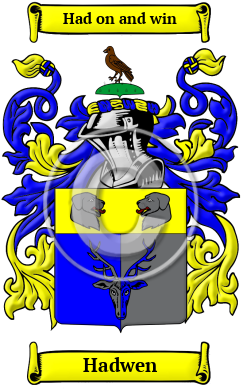
The motto was originally a war cry or slogan. Mottoes first began to be shown with arms in the 14th and 15th centuries, but were not in general use until the 17th century. Thus the oldest coats of arms generally do not include a motto. Mottoes seldom form part of the grant of arms: Under most heraldic authorities, a motto is an optional component of the coat of arms, and can be added to or changed at will; many families have chosen not to display a motto.
Motto: Had on and win
- Convict Records Voyages to Australia (Retrieved 20th April 2022). https://convictrecords.com.au/ships/enchantress
- New Zealand Yesteryears Passenger Lists 1800 to 1900 (Retrieved 26th March 2019). Retrieved from http://www.yesteryears.co.nz/shipping/passlist.html
- The Political Graveyard: Alphabetical Name Index. (Retrieved 2015, November 4) . Retrieved from http://politicalgraveyard.com/alpha/index.html
 |