| ![Show Contents]() Hackness History, Family Crest & Coats of Arms Hackness History, Family Crest & Coats of Arms
Etymology of HacknessWhat does the name Hackness mean? The Strathclyde-Briton people of ancient Scotland were the first to use the name Hackness. The Hackness family lived in Dumfries. Some believe that the surname Hackness is derived from the Old English words here, which means army, and næss, which means headland or cape. 1 Another source claims that name to be "(English or Scandinavian) Dweller at the Temple-Headland [Old English h(e)arg = Old Norse hörg-r, a (heathen) temple + Old English næss = Old Norse nes, a headland]" 2 Early Origins of the Hackness familyThe surname Hackness was first found in Dumfriesshire (Gaelic: Siorrachd Dhùn Phris), a Southern area, bordering on England that today forms part of the Dumfries and Galloway Council Area. "Up to the end of the sixteenth century the notices of this name connect it with Annandale and subsequently with Nithsdale. In the churchyard of Dalgarnock, near Thornhill, are several tombstones of persons of this name, who were mostly tenants of the farms of Locherben and Mitchellslacks in the parish of Close-bum, and Holestane in that of Durrisdeer. James Harkness of Locherben was leader of the band of Covenanters who rescued some Covenanters from the royal troops in the Pass of Enterkin while being convoyed to Edinburgh for trial, 1684. Thomas Harkness, brother of James, was subsequently executed in the Grassmarket of Edinburgh in 1685 for having taken part in the affair." 3 Early History of the Hackness familyThis web page shows only a small excerpt of our Hackness research. Another 174 words (12 lines of text) covering the years 1685, 1809, 1816, 1818, 1820, 1833, 1834, 1843, 1848, 1853, 1854, 1856, 1874, 1878, 1888, 1890 and 1940 are included under the topic Early Hackness History in all our PDF Extended History products and printed products wherever possible. Hackness Spelling VariationsThe variation in the spelling of Medieval names is a result of the lack of spelling rules in the English language prior to the last few hundred years. Before that time, scribes spelled according to sound, often varying the spelling of name within a single document. Hackness has appeared as Harkness, Harkniss, Harckness, Hackness, Herkness and many more. Early Notables of the Hackness familyRobert Harkness (1816-1878), geologist, born at Ormskirk, Lancashire, on 28 July 1816, was educated at Dumfries and at Edinburgh University (1833-1834). He resided at Ormskirk, pursuing scientific studies, until 1848, when he removed with his father to Dumfries. His first paper was read before the Manchester Geological Society in April 1843, on 'The Climate of the Coal Epoch.' His papers on the geology and fossils of south-western Scotland brought him into repute as a geologist, and in 1853 he...
Another 78 words (6 lines of text) are included under the topic Early Hackness Notables in all our PDF Extended History products and printed products wherever possible. Migration of the Hackness family to IrelandSome of the Hackness family moved to Ireland, but this topic is not covered in this excerpt.
Another 63 words (4 lines of text) about their life in Ireland is included in all our PDF Extended History products and printed products wherever possible. Migration of the Hackness familyAs the persecution of Clan families continued, they sailed for North America in increasing numbers. In most cases, they found the freedom and opportunity they sought. Land was often available and the American War of Independence allowed Scots an opportunity to solidify their independence from the English crown. These settlers and their ancestors went on to play essential roles in the forging of the nations of the United States and Canada. Among them: James Harkness and his wife and six children settled in New York State in 1803.
The motto was originally a war cry or slogan. Mottoes first began to be shown with arms in the 14th and 15th centuries, but were not in general use until the 17th century. Thus the oldest coats of arms generally do not include a motto. Mottoes seldom form part of the grant of arms: Under most heraldic authorities, a motto is an optional component of the coat of arms, and can be added to or changed at will; many families have chosen not to display a motto.
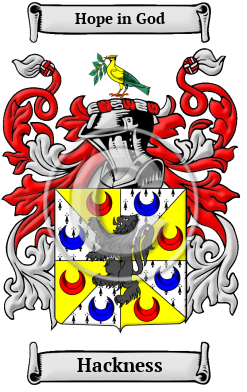
Motto: Hope in God
- Smith, Eldson Coles, New Dictionary of American Family Names New York: Harper & Row, 1956. Print
- Harrison, Henry, Surnames of the United Kingdom: A Concise Etymological Dictionary Baltimore: Geneological Publishing Company, 2013. Print
- Black, George F., The Surnames of Scotland Their Origin, Meaning and History. New York: New York Public Library, 1946. Print. (ISBN 0-87104-172-3)
 |