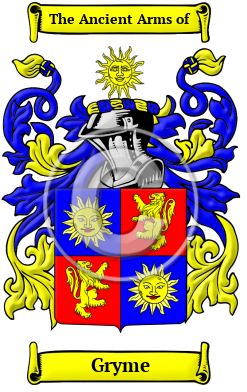
| ![Show Contents]() Gryme History, Family Crest & Coats of Arms Gryme History, Family Crest & Coats of Arms
- Origins Available:
Germany
Etymology of GrymeWhat does the name Gryme mean? The prestigious family surname Gryme originated in the lands which eventually became the modern German state of Prussia. This territory was known for its beautiful landscape, its advanced technology, and its military power. However, in the medieval era, Prussia was fragmented and inhabited by numerous barbarian tribes who fought amongst themselves for control of the land. The borders of the Barbarian kingdoms, which were established after the fall of the Roman Empire, changed repeatedly. The region that came to be known as Prussia was roughly divided among the territories of Brandenburg-Prussia, West Prussia and East Prussia. The Gryme family emerged in Brandenburg-Prussia, which is essentially the birthplace of modern Germany. By the 19th century, Brandenburg-Prussia had incorporated East Prussia, West Prussia and many other German territories. Moreover, in the late 19th century, it led the German states in the unification of Germany. Early Origins of the Gryme familyThe surname Gryme was first found in Prussia, where the name became noted for its many branches within the region, each house acquiring a status and influence which was envied by the princes of the region. The Brother Grimm, Jacob Ludwig Karl Grimm (1785-1863) and Wilhelm Carl Grimm (1786-1859), were German academics, philologists and cultural researchers, born in the town of Hanau in Hesse-Cassel. Their "fairy tales" or "folk stories" were complied in seven editions with many revisions in each edition. The collection included "Cinderella" ("Aschenputtel"), "The Frog Prince" ("Der Froschkönig"), ("Die Gänsemagd"), "Hansel and Gretel" ("Hänsel und Gretel"), "Rapunzel", "Beauty and the Beast", "Little Red Riding Hood", "The Wolf and the Seven Young Goats", "The Three Little Pigs" and many more. In England, Edward Grim (fl. 1170-1177), was a biographer of Becket, a native of Cambridge, a clerk, and had attained the degree of Master at some university before the end of 1170, when he visited Thomas Becket on the latter's return to Canterbury. "On the fatal evening, 29 Dec., Grim accompanied Thomas into the church, stood by him during his altercation with the knights, and shielded him from their violence, till, his own arm being nearly cut off by a stroke aimed at the primate, he fell to the ground, but was able to crawl away to the altar where the archbishop's other clerks had taken refuge, and thus escaped with his life." 1 Early History of the Gryme familyThis web page shows only a small excerpt of our Gryme research. Another 96 words (7 lines of text) covering the years 1785, 1786, 1792, 1828, 1859, 1863 and 1901 are included under the topic Early Gryme History in all our PDF Extended History products and printed products wherever possible. Gryme Spelling VariationsIn the medieval era, many different cultural groups lived in the German states. There are thus many regional variations of German surnames from that era. Westphalians spoke Low German, which is similar to modern Dutch. Many German names carry suffixes that identify where they came from. Others have phrases attached that identify something about the original bearer. Other variations in German names resulted from the fact that medieval scribes worked without the aid of any spelling rules. The spelling variations of the name Gryme include Grimm, Grim, Grimme, Grimmen, Grimmer, Grimer, Grymm and many more. Early Notables of the Gryme familyJacob (1785-1863) and his brother Wilhelm Grimm (1786-1859), born in Hessen, who were the founders of folklore as well as historians of the German language; their dictionary and collection of fairy tales are...
Another 33 words (2 lines of text) are included under the topic Early Gryme Notables in all our PDF Extended History products and printed products wherever possible.
| Gryme migration to the United States | + |
Since medieval times, the state of Prussia has played an important part in the history of Germany. The state's military powers were historically very strong, and endured until after the Second World War, when the territory was broken up and divided between the Soviet Union, Poland, East Germany and West Germany. A spurt of migration followed, with some Prussians going elsewhere in Europe and many others crossing the ocean to North America. Most entered the United States through Philadelphia. Some remained there, while more moved on to the states of Ohio, Texas, Illinois, California, New York, and Maryland. Others traveled to Canada and settled Ontario and the prairie provinces. Research into the origins of individual families in North America revealed records of the immigration of a number of people bearing the name Gryme or a variant listed above:
Gryme Settlers in United States in the 17th Century- John Gryme, who landed in Virginia in 1655 2
- Smith, George (ed), Dictionary of National Biography. London: Smith, Elder & Co., 1885-1900. Print
- Filby, P. William, Meyer, Mary K., Passenger and immigration lists index : a guide to published arrival records of about 500,000 passengers who came to the United States and Canada in the seventeenth, eighteenth, and nineteenth centuries. 1982-1985 Cumulated Supplements in Four Volumes Detroit, Mich. : Gale Research Co., 1985, Print (ISBN 0-8103-1795-8)
 |