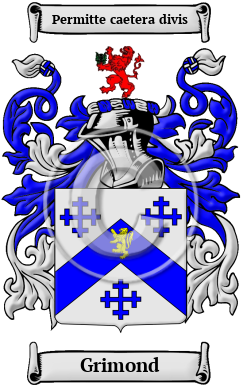
| ![Show Contents]() Grimond History, Family Crest & Coats of Arms Grimond History, Family Crest & Coats of Arms
- Origins Available:
Scotland
Etymology of GrimondWhat does the name Grimond mean? In ancient Scotland, the ancestors of the name Grimond lived in the Kingdom of Dalriada. In those days the name Grimond was used to indicate a person who person noted as a guardian. The name, which is Mac Cruimein in Gaelic, is derived from the Old Norse Hromund, which means famed protector. "The late Dr. Alexander Carmichael, who gives the Gaelic form of the name as Maccriomthain, says that a woman of the name in St. Kilda recited some of the island songs to him. " 1 Interestingly, Crimond is a parish, in the district of Deer, county of Aberdeen. "This place once contained a castle belonging to the celebrated Cumyn, Earl of Buchan, which stood on a small hill called Castlehill, and was suffered to fall into ruins after his fatal defeat at the battle of Inverury by Robert Bruce. " 2 Early Origins of the Grimond familyThe surname Grimond was first found in on the Isle of Skye, where they were hereditary Pipers to the MacLeods of Dunvegan and founded the famous College of Piping, the most celebrated of its kind in the world. "A family of the name were hereditary pipers to Macleod of Macleod, the last of whom, Lieut. MacCrimmon, had a farm in Glenelg in the first quarter of the nineteenth century. The name is found on one of the rune-inscribed crosses at Kirk Michael, Isle of Man, as Rumun. " 1 Interestingly, Crimond is a parish, in the district of Deer, county of Aberdeen. "This place once contained a castle belonging to the celebrated Cumyn, Earl of Buchan, which stood on a small hill called Castlehill, and was suffered to fall into ruins after his fatal defeat at the battle of Inverury by Robert Bruce. " 2 Early History of the Grimond familyThis web page shows only a small excerpt of our Grimond research. Another 97 words (7 lines of text) covering the year 1533 is included under the topic Early Grimond History in all our PDF Extended History products and printed products wherever possible. Grimond Spelling VariationsThe translation of Gaelic names in the Middle Ages was not a task undertaken with great care. Records from that era show an enormous number of spelling variations, even in names referring to the same person. Over the years Grimond has appeared as MacCrimmon, MacRimmon, MacCrummen, MacCrummin, Crimmon, Crimmons, Crimmin and many more. Early Notables of the Grimond familyMore information is included under the topic Early Grimond Notables in all our PDF Extended History products and printed products wherever possible. Migration of the Grimond familyThe descendants of the Dalriadan families who made the great crossing of the Atlantic still dot communities along the east coast of the United States and Canada. In the American War of Independence, many of the settlers traveled north to Canada as United Empire Loyalists. Clan societies and highland games have allowed Canadian and American families of Scottish descent to recover much of their lost heritage. Investigation of the origins of family names on the North American continent has revealed that early immigrants bearing the name Grimond or a variant listed above include: Donald MacCrimmon, who arrived in Philadelphia in 1847; W. Crimmond arrived in New York in 1822; John Crimmin arrived in Philadelphia in 1861.
| Contemporary Notables of the name Grimond (post 1700) | + |
- Joseph Grimond CH CBE TD PC (1913-1993), Baron Grimond, British politician, leader of the Liberal Party from 1956 to 1967
The motto was originally a war cry or slogan. Mottoes first began to be shown with arms in the 14th and 15th centuries, but were not in general use until the 17th century. Thus the oldest coats of arms generally do not include a motto. Mottoes seldom form part of the grant of arms: Under most heraldic authorities, a motto is an optional component of the coat of arms, and can be added to or changed at will; many families have chosen not to display a motto.
Motto: Permitte caetera divis
Motto Translation: Leave the rest to the Gods.
- Black, George F., The Surnames of Scotland Their Origin, Meaning and History. New York: New York Public Library, 1946. Print. (ISBN 0-87104-172-3)
- Lewis, Samuel, A Topographical Dictionary of Scotland. Institute of Historical Research, 1848, Print.
 |