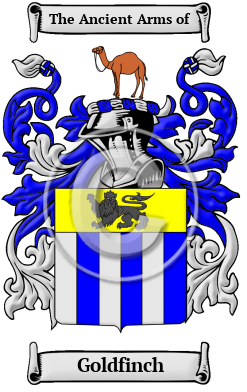
| ![Show Contents]() Goldfinch History, Family Crest & Coats of Arms Goldfinch History, Family Crest & Coats of Arms
- Origins Available:
England
Etymology of GoldfinchWhat does the name Goldfinch mean? The name Goldfinch is a nickname from the goldfinch bird. 1 2 3 The variant Goldspink was a Eurasian goldfinch (Carduelis carduelis) but as a surname, it is almost exclusively found in Australia and New Zealand today. 2 1 Early Origins of the Goldfinch familyThe surname Goldfinch was first found in Cambridgeshire where the Assize Rolls of 1260 records WIlliam Goldfing as holding lands there at that time. A few years later Robert Goldfynch was recorded in the Assize Rolls for Somerset in 1277 and Phillip Goldfynch was found in the Assize Rolls for Staffordshire in 1307. 4 The Hundredorum Rolls of 1273 include an entry for Agnes Goldfinche, Oxfordshire, and later the Yorkshire Poll Tax Rolls of 1379 include William Goldfynch. B. Ricardus Goldfynch. 2 Early History of the Goldfinch familyThis web page shows only a small excerpt of our Goldfinch research. Another 83 words (6 lines of text) covering the years 1277, 1455, 1487 and 1888 are included under the topic Early Goldfinch History in all our PDF Extended History products and printed products wherever possible. Goldfinch Spelling VariationsBefore the last few hundred years, the English language had no fast system of spelling rules. For that reason, spelling variations are commonly found in early Anglo-Saxon surnames. Over the years, many variations of the name Goldfinch were recorded, including Goldfinch, Goldfinche, Goldfink, Goldspink, Goldfynch and many more. Early Notables of the Goldfinch family- R Goldfinch who discovered a fossilized elephant in Yorkshire in 1888
| Goldfinch migration to the United States | + |
To escape oppression and starvation at that time, many English families left for the "open frontiers" of the New World with all its perceived opportunities. In droves people migrated to the many British colonies, those in North America in particular, paying high rates for passages in cramped, unsafe ships. Although many of the settlers did not make the long passage alive, those who did see the shores of North America perceived great opportunities before them. Many of the families that came from England went on to make essential contributions to the emerging nations of Canada and the United States. Research into various historical records revealed some of first members of the Goldfinch family emigrate to North America:
Goldfinch Settlers in United States in the 17th Century- John Goldfinch, who settled in Virginia in 1658
- Jone Goldfinch, who arrived in Virginia in 1658 6
- Peter Goldfinch, who landed in Virginia in 1696 6
- Peter Goldfinch, who settled in Virginia in 1698
| Goldfinch migration to Australia | + |
Emigration to Australia included the First Fleet of convicts, tradespeople and early settlers. Early immigrants include: First Fleet - Mr. Thomas Goldfinch, (b. 1761), aged 28, British settler convicted in Middlesex, England in 1788, sentenced to 14 years for theft, transported aboard the ship "Scarborough" leaving in 1789 arriving in New South Wales, Australia in 1790 5
Following the First Fleet, other convicts and early settlers arriving in Australia include: Goldfinch Settlers in Australia in the 19th Century- Mary Ann Goldfinch, who arrived in Adelaide, Australia aboard the ship "Lloyds" in 1838 7
- Henry Goldfinch, who arrived in Adelaide, Australia aboard the ship "Lloyds" in 1838 7
- Henry Goldfinch, who arrived in Adelaide, Australia aboard the ship "Recovery" in 1839 8
- Richard Goldfinch, who arrived in Adelaide, Australia aboard the ship "Harpley" in 1848 9
- Eugenie Goldfinch, who arrived in Adelaide, Australia aboard the ship "Harpley" in 1848 9
- ... (More are available in all our PDF Extended History products and printed products wherever possible.)
| Goldfinch migration to New Zealand | + |
Emigration to New Zealand followed in the footsteps of the European explorers, such as Captain Cook (1769-70): first came sealers, whalers, missionaries, and traders. By 1838, the British New Zealand Company had begun buying land from the Maori tribes, and selling it to settlers, and, after the Treaty of Waitangi in 1840, many British families set out on the arduous six month journey from Britain to Aotearoa to start a new life. Early immigrants include: Goldfinch Settlers in New Zealand in the 19th Century- Robert Lynch Goldfinch, who landed in Wairarapa, New Zealand in 1840
- Mr. William Goldfinch, (b. 1849), aged 30, British settler travelling from Plymouth aboard the ship "Stad Haarlem" arriving in Wellington, New Zealand in 1879 10
- Mrs. Emma Goldfinch, (b. 1855), aged 24, British settler travelling from Plymouth aboard the ship "Stad Haarlem" arriving in Wellington, New Zealand in 1879 10
- Mr. Robert H. Goldfinch, (b. 1875), aged 4, British settler travelling from Plymouth aboard the ship "Stad Haarlem" arriving in Wellington, New Zealand in 1879 10
| Contemporary Notables of the name Goldfinch (post 1700) | + |
- Stephen Goldfinch (b. 1982), American politician, Member of the South Carolina Senate (2016-), Member of the South Carolina House of Representatives (2012-2016)
- Flight lieutenant Bill Goldfinch (1916-2007), English Royal Air Force pilot who co-built a glider in an attic of Colditz Castle, one of the most audacious of escape attempts from the famous World War II prison camp
- Sir Philip Henry Macarthur Goldfinch KBE (1884-1943), English-born, Australian politician, Member for Gordon NSW (1935-1937)
- Lt-General Henry Goldfinch KCB (1781-1854), British officer in the Royal Engineers who served during the Peninsular War of 1807 to 1814
- Murray Goldfinch (b. 1984), Australian Paralympic bronze medal at the 2000 Sydney Games
- Duncan Goldfinch (1888-1960), South Australian painter, noted for his watercolors of Central Australia.
- Sir Arthur Horne Goldfinch (1866-1945), British businessman and Liberal Party politician, born in Valparaiso, Chile
- Lower, Mark Anthony, Patronymica Britannica, A Dictionary of Family Names of the United Kingdom. London: John Russel Smith, 1860. Print.
- Bardsley, C.W, A Dictionary of English and Welsh Surnames: With Special American Instances. Wiltshire: Heraldry Today, 1901. Print. (ISBN 0-900455-44-6)
- Harrison, Henry, Surnames of the United Kingdom: A Concise Etymological Dictionary Baltimore: Geneological Publishing Company, 2013. Print
- Reaney, P.H and R.M. Wilson, A Dictionary of English Surnames. London: Routledge, 1991. Print. (ISBN 0-415-05737-X)
- Convict Records of Australia. Retrieved 4th February 2021 from https://convictrecords.com.au/ships
- Filby, P. William, Meyer, Mary K., Passenger and immigration lists index : a guide to published arrival records of about 500,000 passengers who came to the United States and Canada in the seventeenth, eighteenth, and nineteenth centuries. 1982-1985 Cumulated Supplements in Four Volumes Detroit, Mich. : Gale Research Co., 1985, Print (ISBN 0-8103-1795-8)
- State Records of South Australia. (Retrieved 2010, November 5) LLOYDS from London 1838. Retrieved from http://www.slsa.sa.gov.au/BSA/1838Lloyds.htm
- State Records of South Australia. (Retrieved 2010, November 5) RECOVERY from London 1839. Retrieved from http://www.slsa.sa.gov.au/BSA/1839Recovery.htm
- State Records of South Australia. (Retrieved 2010, November 5) The HARPLEY 1848 - PASSENGER LIST. Retrieved from http://www.slsa.sa.gov.au/BSA/1848HarpleyPassengerList.htm
- New Zealand Yesteryears Passenger Lists 1800 to 1900 (Retrieved 26th March 2019). Retrieved from http://www.yesteryears.co.nz/shipping/passlist.html
 |