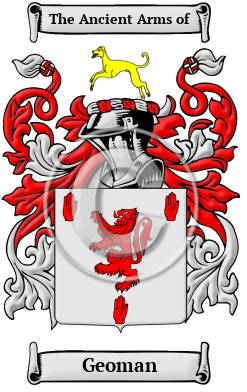
| ![Show Contents]() Geoman History, Family Crest & Coats of Arms Geoman History, Family Crest & Coats of Arms
- Origins Available:
Ireland
Etymology of GeomanWhat does the name Geoman mean? The original Gaelic form of the Geoman surname is Mag Eochagain, a patronymic derived from the personal name Eochaidh. Early Origins of the Geoman familyThe surname Geoman was first found in the county of Westmeath (Irish: An Iarmhí) in the Irish Midlands, province of Leinster, in the barony of Moycashel at Kilbeggan where they held a family seat from ancient times. Traditionally, the Geomans are said to descend from Fiacha, son of Niall of the Nine Hostages. Early History of the Geoman familyThis web page shows only a small excerpt of our Geoman research. Another 148 words (11 lines of text) covering the years 1172, 1186, 1291, 1580, 1600, 1603, 1650, 1689, 1702, 1749, 1763 and 1800 are included under the topic Early Geoman History in all our PDF Extended History products and printed products wherever possible. Geoman Spelling VariationsThe archives that survive today demonstrate the difficulty experienced by the scribes of this period in their attempts to record these names in writing. Spelling variations of the name Geoman dating from that time include Geoghegan, Gagahan, Gahagan, Gahaghan, Gaghan, Gegan, MacGeoghegan, Geohan and many more. Early Notables of the Geoman familyConal MacGeoghegan (circa 1580-1650) Chief of the sept MacGeoghegan, historian who translated the Annals of Clonmacnoise; James MacGeoghegan (1702-1763) of Westmeath, an ordained priest in Paris, who wrote a "History of Ireland;" and Edward Geoghegan of Dublin was one of the most eminent surgeons of his time (early 1800s).
Usher Gagahan (d. 1749), was an Irish classical scholar, belonged to a good family of Westmeath, Ireland; was educated at Trinity College, Dublin, but took no degree, and then proceeded to study for...
Another 80 words (6 lines of text) are included under the topic Early Geoman Notables in all our PDF Extended History products and printed products wherever possible.
| Geoman migration to the United States | + |
Thousands of Irish left in their homeland in the 18th and 19th centuries to escape the religious and political discrimination they experienced primarily at the hands of the English, and in the search of a plot of land to call their own. These immigrants arrived at the eastern shores of North America, early on settling and breaking the land, and, later, building the bridges, canals, and railroads essential to the emerging nations of United States and Canada. Many others would toil for low wages in the dangerous factories of the day. Although there had been a steady migration of Irish to North America over these years, the greatest influx of Irish immigrants came to North America during the Great Potato Famine of the late 1840s. Early North American immigration records have revealed a number of people bearing the Irish name Geoman or a variant listed above:
Geoman Settlers in United States in the 19th Century- Gilbert Geoman, who arrived in San Francisco, California in 1851 1
- Filby, P. William, Meyer, Mary K., Passenger and immigration lists index : a guide to published arrival records of about 500,000 passengers who came to the United States and Canada in the seventeenth, eighteenth, and nineteenth centuries. 1982-1985 Cumulated Supplements in Four Volumes Detroit, Mich. : Gale Research Co., 1985, Print (ISBN 0-8103-1795-8)
 |