| ![Show Contents]() Forret History, Family Crest & Coats of Arms Forret History, Family Crest & Coats of Arms
Etymology of ForretWhat does the name Forret mean? In the ancient Scottish-English border region, the ancestors of the name Forret lived among the Boernicians. They lived in areas near or inside a forest. Some research suggests that the surname is also a shortened form of Forester. The Middle English word forest referred specifically to an area of woodland reserved by law as hunting grounds for the king or his nobles. As such, the surname, Forret would have appeared independently in various parts of Britain. Early Origins of the Forret familyThe surname Forret was first found in Newlands, a parish, in the historic county of Peeblesshire. 1 The first on record was William de Forest who was a tenant of the Douglases in the barony of Newlands in 1376. In the same year, Hugh de Forest was a Douglas tenant in Drumcorke. A few years later, Morgan de Forest in Aberdeen was "cherged" with being a forestaller in 1402 and Master Thomas de Foresta, licentiate in decrees, was rector of the parish of Soudon (Southdean) in 1404. 2 Early History of the Forret familyThis web page shows only a small excerpt of our Forret research. Another 187 words (13 lines of text) covering the years 1379, 1390, 1411, 1430, 1453, 1463, 1472, 1518, 1520, 1526, 1527, 1533, 1540, 1588, 1602, 1608, 1633, 1635, 1642, 1654, 1664, 1668, 1698, 1701, 1703, 1706, 1709, 1711, 1714, 1715, 1720 and 1890 are included under the topic Early Forret History in all our PDF Extended History products and printed products wherever possible. Forret Spelling VariationsSpelling rules only evolved in the last few centuries with the invention of the printing press and the first dictionaries. Spelling variations are extremely common in names from before that period. Forret has been spelled Forrester, Forester, Forrest, Forster, Foster, Forrestor and many more. Early Notables of the Forret family- Thomas Forret (d. 1540), was vicar of Dollar, Clackmannanshire, and Scottish martyr, descended from an old family which possessed the estate of Forret in the parish of Logie, Fifeshire, from the reign...
Migration of the Forret family to IrelandSome of the Forret family moved to Ireland, but this topic is not covered in this excerpt.
Another 129 words (9 lines of text) about their life in Ireland is included in all our PDF Extended History products and printed products wherever possible. Migration of the Forret familyAfter making their great crossing, many Boernician-Scottish families settled along the east coast of North America. When the War of Independence broke out, United Empire Loyalists moved north to Canada while the rest stayed to fight. The ancestors of many of these Scots still populate the continent. This century, through Clan societies and other Scottish organizations, they began to rediscover their collective national heritage. Analysis of immigration records indicates that some of the first North American immigrants bore the name Forret or a variant listed above: James Forest, who settled in Virginia in 1654; George Forest settled in Virginia in 1608; 12 years before the "Mayflower"; Toby Forrester settled in Virginia in 1655.
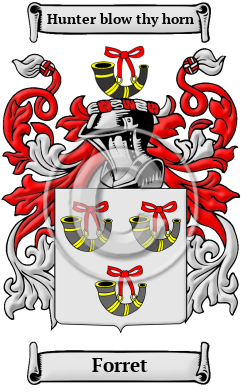
The motto was originally a war cry or slogan. Mottoes first began to be shown with arms in the 14th and 15th centuries, but were not in general use until the 17th century. Thus the oldest coats of arms generally do not include a motto. Mottoes seldom form part of the grant of arms: Under most heraldic authorities, a motto is an optional component of the coat of arms, and can be added to or changed at will; many families have chosen not to display a motto.
Motto: Hunter blow thy horn
- Lewis, Samuel, A Topographical Dictionary of Scotland. Institute of Historical Research, 1848, Print.
- Black, George F., The Surnames of Scotland Their Origin, Meaning and History. New York: New York Public Library, 1946. Print. (ISBN 0-87104-172-3)
 |