
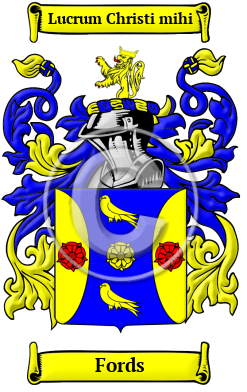
Show ContentsFords History, Family Crest & Coats of Arms

Etymology of Fords

What does the name Fords mean?

As an Irish surname, Fords was an Anglicized version of three different Gaelic names: "Mac Giolla Naomh," meaning "son of the devotee of the saints" was a Sept that originated in southern Connemara. The name also comes from "Mac Consnámha," or "son of the swimming hound." This Connacht Sept has also been Anglicized as Kinneavy. Lastly, in Cork, the name was an Anglicized version of "Fuaráin", though more often it was Anglicized as Foran. There are also many Irish bearers of this name, who are ultimately of English origin. The English name comes from the Old English word "ford," which denotes a shallow section of a river, where it can be crossed. One large family came to County Meath from Devon in the 14th century where they became large land-holders.

Early Origins of the Fords family

The surname Fords was first found in Connacht (Irish: Connachta, (land of the) descendants of Conn), and in County Cork where several distinct Irish Septs all came to be known by the English name Fords.

Early History of the Fords family

This web page shows only a small excerpt of our Fords research. Another 55 words (4 lines of text) covering the years 1172, 1355 and 1604 are included under the topic Early Fords History in all our PDF Extended History products and printed products wherever possible.

Fords Spelling Variations

Spelling variations of this family name include: Ford, Forde and others.

Early Notables of the Fords family

More information is included under the topic Early Fords Notables in all our PDF Extended History products and printed products wherever possible.


Fords migration to the United States +


Fords Settlers in United States in the 19th Century
  • Sigmund Fords, who arrived in Allegany (Allegheny) County, Pennsylvania in 1845 1


The Fords Motto +

The motto was originally a war cry or slogan. Mottoes first began to be shown with arms in the 14th and 15th centuries, but were not in general use until the 17th century. Thus the oldest coats of arms generally do not include a motto. Mottoes seldom form part of the grant of arms: Under most heraldic authorities, a motto is an optional component of the coat of arms, and can be added to or changed at will; many families have chosen not to display a motto.

Motto: Lucrum Christi mihi
Motto Translation: Without Christ, there is no light.


  1. Filby, P. William, Meyer, Mary K., Passenger and immigration lists index : a guide to published arrival records of about 500,000 passengers who came to the United States and Canada in the seventeenth, eighteenth, and nineteenth centuries. 1982-1985 Cumulated Supplements in Four Volumes Detroit, Mich. : Gale Research Co., 1985, Print (ISBN 0-8103-1795-8)


Houseofnames.com on Facebook