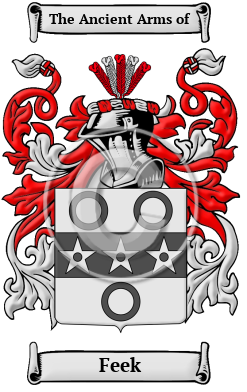
| ![Show Contents]() Feek History, Family Crest & Coats of Arms Feek History, Family Crest & Coats of Arms
Etymology of FeekWhat does the name Feek mean? The name Feek is "a Norman-French form of the Old French word "ficheis" meaning "faithful." 1. Early Origins of the Feek familyThe surname Feek was first found in London, England where Thomas le Fykes, Fykeis was recorded in 1281. Later in Kent, the Assize Rolls listed William Fykays in 1317. 1 A scan through early Sussex records revealed John le Figge listed in the Subsidy Rolls of 1327 and later in London, Simon Figge was recorded in 1381. 1 In Ireland, the name "is found in English records as early as the thirteenth century. but does not appear to have been established in mediaeval Ireland. In this country it is of comparatively recent introduction being chiefly associated with Dublin, where it has been prominent in the publishing and bookselling business since 1809. Darrell Figges (1882-1925), the author who was active in the revolutionary movement from 1914, was born in Dublin." 2 Early History of the Feek familyThis web page shows only a small excerpt of our Feek research. Another 162 words (12 lines of text) covering the years 1102, 1139, 1234, 1273, 1391, 1429, 1455, 1487, 1510, 1533, 1600, 1645, 1660, 1695, 1719, 1730, 1734 and 1992 are included under the topic Early Feek History in all our PDF Extended History products and printed products wherever possible. Feek Spelling VariationsFeek has been spelled many different ways. Before English spelling became standardized over the last few hundred years, spelling variations in names were a common occurrence. As the English language changed in the Middle Ages, absorbing pieces of Latin and French, as well as other languages, the spelling of people's names also changed considerably, even over a single lifetime. Spelling variants included: Figg, Figgiss, Figgess, Figgins, Figgin, Figges, Figgess, Figgs, Fig, Fyge, Fygg, Fygge, Ficke, Feek and many more. Early Notables of the Feek familyJames Figg (1695-1734), English bare-knuckle boxer, generally agreed first English bare-knuckle boxing champion, reigning from 1719 to 1730 or 1734, inducted into the International Boxing Hall...
Another 26 words (2 lines of text) are included under the topic Early Feek Notables in all our PDF Extended History products and printed products wherever possible. Migration of the Feek family to IrelandSome of the Feek family moved to Ireland, but this topic is not covered in this excerpt.
Another 38 words (3 lines of text) about their life in Ireland is included in all our PDF Extended History products and printed products wherever possible.
| Feek migration to New Zealand | + |
Emigration to New Zealand followed in the footsteps of the European explorers, such as Captain Cook (1769-70): first came sealers, whalers, missionaries, and traders. By 1838, the British New Zealand Company had begun buying land from the Maori tribes, and selling it to settlers, and, after the Treaty of Waitangi in 1840, many British families set out on the arduous six month journey from Britain to Aotearoa to start a new life. Early immigrants include: Feek Settlers in New Zealand in the 19th Century- William Feek, aged 49, a farm labourer, who arrived in Wellington, New Zealand aboard the ship "Halcione" in 1875 3
- Maria Feek, aged 33, who arrived in Wellington, New Zealand aboard the ship "Halcione" in 1875 3
- Betsy Feek, aged 11, who arrived in Wellington, New Zealand aboard the ship "Halcione" in 1875 3
- William Feek, aged 9, who arrived in Wellington, New Zealand aboard the ship "Halcione" in 1875 3
- Emma Feek, aged 6, who arrived in Wellington, New Zealand aboard the ship "Halcione" in 1875 3
- ... (More are available in all our PDF Extended History products and printed products wherever possible.)
- Reaney, P.H and R.M. Wilson, A Dictionary of English Surnames. London: Routledge, 1991. Print. (ISBN 0-415-05737-X)
- MacLysaght, Edward, Supplement to Irish Families. Baltimore: Genealogical Book Company, 1964. Print.
- New Zealand Yesteryears Passenger Lists 1800 to 1900 (Retrieved 12th December 2018). Retrieved from http://www.yesteryears.co.nz/shipping/passlist.html
 |