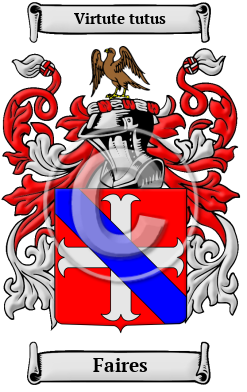
| ![Show Contents]() Faires History, Family Crest & Coats of Arms Faires History, Family Crest & Coats of Arms
Etymology of FairesWhat does the name Faires mean? The Faires surname in Ireland is generally thought to have come from a translation of the Gaelic "fionn," meaning "fair." More often than not, the spelling in use in Ireland is with the "ph" as in Phair or Phayr. 1 Thus the name was originally given to one with fair hair or of a fair disposition and means "son of the fair one" Early Origins of the Faires familyThe surname Faires was first found in Ireland where according to O'Hart, the "family name came into Ireland with the Cromwellian Settlement, or with the Revolution." (O'Hart) This name is scattered throughout Ireland and instances of it nowadays are rare. However in its original form, Fionn, it holds an important part in Irish mythology, being the first name of the legendary hero, Fionn MacCumhaill, leader of the mighty warriors the Fianna. It is generally thought that this Irish family was a branch from the family residing in Devon, England. Early History of the Faires familyThis web page shows only a small excerpt of our Faires research. Another 22 words (2 lines of text) covering the years 1612, 1619, 1648, 1649, 1650, 1651, 1654, 1662 and 1682 are included under the topic Early Faires History in all our PDF Extended History products and printed products wherever possible. Faires Spelling VariationsSpelling variations of this family name include: Fair, Faire, Faires, Fayer, Fayers, Fairs, Fare, Phair, Phaire, Phayre, Phares and many more. Early Notables of the Faires familyRobert Phayre (c.1619-1682) Governor of Cork, and soldier, one of the Regicides of King Charles I of England. He was held at the Tower of London, but after paying a substantial ransom and marrying the Protestant daughter of the Governor of the Tower of London, he was released in 1662. He came into prominence in connection with the outbreak of the second civil war. In February 1648 he held a command as lieutenant-colonel in the south of Ireland, when he was arrested, with three other officers, for refusing to join the royalist rising under Murrough O'Brien, first Earl of Inchiquin. On...
Another 231 words (16 lines of text) are included under the topic Early Faires Notables in all our PDF Extended History products and printed products wherever possible.
| Faires migration to New Zealand | + |
Emigration to New Zealand followed in the footsteps of the European explorers, such as Captain Cook (1769-70): first came sealers, whalers, missionaries, and traders. By 1838, the British New Zealand Company had begun buying land from the Maori tribes, and selling it to settlers, and, after the Treaty of Waitangi in 1840, many British families set out on the arduous six month journey from Britain to Aotearoa to start a new life. Early immigrants include: Faires Settlers in New Zealand in the 19th Century- Mr. Thomas Jackson Faires, (1831), aged 29, British saddler travelling from Gravesend, England aboard the ship "Clontarf" arriving in Canterbury, New Zealand on 16th March 1860
- Mrs. Sarah Jane Faires, (1834), aged 26, British settler travelling from Gravesend, England aboard the ship "Clontarf" arriving in Canterbury, New Zealand on 16th March 1860
- Miss Lucy Emma Faires, (1859), aged 1, British settler travelling from Gravesend, England aboard the ship "Clontarf" arriving in Canterbury, New Zealand on 16th March 1860, she died on board
- Mr. James Faires, (1844), aged 16, British settler travelling from Gravesend, England aboard the ship "Clontarf" arriving in Canterbury, New Zealand on 16th March 1860
- Mr. Robert Faires, (1846), aged 14, British settler travelling from Gravesend, England aboard the ship "Clontarf" arriving in Canterbury, New Zealand on 16th March 1860
- ... (More are available in all our PDF Extended History products and printed products wherever possible.)
The motto was originally a war cry or slogan. Mottoes first began to be shown with arms in the 14th and 15th centuries, but were not in general use until the 17th century. Thus the oldest coats of arms generally do not include a motto. Mottoes seldom form part of the grant of arms: Under most heraldic authorities, a motto is an optional component of the coat of arms, and can be added to or changed at will; many families have chosen not to display a motto.
Motto: Virtute tutus
Motto Translation: By Virtue Safe
- MacLysaght, Edward, Supplement to Irish Families. Baltimore: Genealogical Book Company, 1964. Print.
 |