
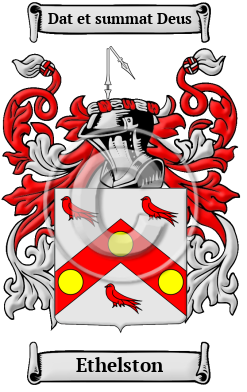
Show ContentsEthelston History, Family Crest & Coats of Arms

Early Origins of the Ethelston family

The surname Ethelston was first found in Lancashire where they held a family seat as Lords of the Manor. The Saxon influence of English history diminished after the Battle of Hastings in 1066. The language of the courts was French for the next three centuries and the Norman ambience prevailed. But Saxon surnames survived and the family name was first referenced in the 13th century when they held estates in that shire.

Early History of the Ethelston family

This web page shows only a small excerpt of our Ethelston research. Another 156 words (11 lines of text) covering the years 1437, 1455, 1487, 1510 and 1600 are included under the topic Early Ethelston History in all our PDF Extended History products and printed products wherever possible.

Ethelston Spelling Variations

Spelling variations of this family name include: Ethelstan, Ethelston, Ethelstone, Ethelstane, Ethlestone, Ethlestan, Thelston and many more.

Early Notables of the Ethelston family

More information is included under the topic Early Ethelston Notables in all our PDF Extended History products and printed products wherever possible.


Ethelston migration to the United States +


Ethelston Settlers in United States in the 20th Century
  • Frank P. Ethelston, aged 34, British settler who arrived in New York aboard the ship "Adriatic" in 1916 1
  • F. E. Ethelston, aged 22, British settler who arrived in New York aboard the ship "Thomas H. Barry" in 1942 1

Contemporary Notables of the name Ethelston (post 1700) +

  • Ellen Mary Ethelston, English daughter of the Rev Charles Wicksted Ethelston of Upplyme who married Charles Joseph Parke (1820-1893)
  • Charles Wickstead Ethelston (1767-1830), English cleric, now remembered for the part he played in his role as magistrate on 16 August 1819, ahead of the Peterloo massacre
  • Commander Alfred Peel Ethelston, British naval officer who died serving with the HMS Powerful, eponym of the Commander Ethelston Charity Cup, one of the most prestigious amateur football trophies in England


The Ethelston Motto +

The motto was originally a war cry or slogan. Mottoes first began to be shown with arms in the 14th and 15th centuries, but were not in general use until the 17th century. Thus the oldest coats of arms generally do not include a motto. Mottoes seldom form part of the grant of arms: Under most heraldic authorities, a motto is an optional component of the coat of arms, and can be added to or changed at will; many families have chosen not to display a motto.

Motto: Dat et summat Deus
Motto Translation: God gives and God takes away.


  1. Ellis Island Search retrieved 21st October 2021. Retrieved from https://heritage.statueofliberty.org/passenger-result


Houseofnames.com on Facebook