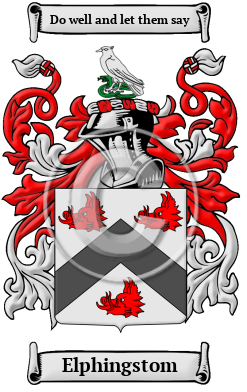
| ![Show Contents]() Elphingstom History, Family Crest & Coats of Arms Elphingstom History, Family Crest & Coats of Arms
- Origins Available:
Scotland
Early Origins of the Elphingstom familyThe surname Elphingstom was first found in Midlothian, where they were granted lands by King Robert the I of Scotland. Elvington is a parish in the East Riding or Yorkshire. "This place derives its name, according to some, from the ancient eel-fisheries in the district; according to others, from Aluf, a Saxon, to whom Elvington, then written Alvintone, is described in Domesday Book as belonging: some, again, deduce it from the Latin Alveus." 1 Early History of the Elphingstom familyThis web page shows only a small excerpt of our Elphingstom research. Another 139 words (10 lines of text) covering the years 1296, 1300, 1431, 1510, 1513, 1514, 1530, 1547, 1552, 1553, 1577, 1602, 1612, 1638, 1647, 1648, 1649, 1654, 1669 and 1718 are included under the topic Early Elphingstom History in all our PDF Extended History products and printed products wherever possible. Elphingstom Spelling VariationsSpelling variations of this family name include: Elphinstone, Elphinston, Elphingston and many more. Early Notables of the Elphingstom familyWilliam Elphinstone (1431-1514), Scottish statesman, Bishop of Aberdeen and founder of the University of Aberdeen; Alexander Elphinstone, 1st Lord Elphinstone (died 1513) killed at the Battle of Flodden in September 1513; Alexander Elphinstone, 2nd Lord Elphinstone (1510-1547); Robert Elphinstone, 3rd Lord Elphinstone (1530-1602); Alexander Elphinstone, 4th Lord Elphinstone...
Another 47 words (3 lines of text) are included under the topic Early Elphingstom Notables in all our PDF Extended History products and printed products wherever possible. Migration of the Elphingstom familySome of the first settlers of this family name or some of its variants were: Will and Anne Elphingston who settled in Georgia in 1733; Alexander Elphinstone arrived in Philadelphia in 1860.
The motto was originally a war cry or slogan. Mottoes first began to be shown with arms in the 14th and 15th centuries, but were not in general use until the 17th century. Thus the oldest coats of arms generally do not include a motto. Mottoes seldom form part of the grant of arms: Under most heraldic authorities, a motto is an optional component of the coat of arms, and can be added to or changed at will; many families have chosen not to display a motto.
Motto: Do well and let them say
- Lewis, Samuel, A Topographical Dictionary of England. Institute of Historical Research, 1848, Print.
 |