| ![Show Contents]() Duplantie History, Family Crest & Coats of Arms Duplantie History, Family Crest & Coats of Arms
- Origins Available:
France
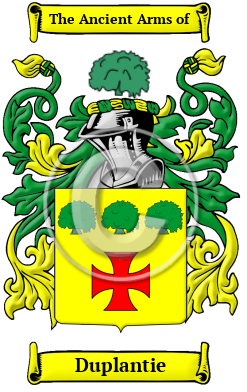
Etymology of DuplantieWhat does the name Duplantie mean? The French name Duplantie first arose during the Medieval period in Normandy (French: Normandie). It is derived from when the family having lived in Normandy at the Seigneury De Planques, from which their name is derived. Early Origins of the Duplantie familyThe surname Duplantie was first found in Normandy, the former Duchy of Normandy, where they were formerly seated in the honour of the seigneurie of De Planques in the region of Pas de Calais in the arrondissement of Montreuil sur Mer. The family emerged at Wildenberg as a family of great distinction being descended from Conrad, Count de Rauzen, a Marshall of all France in 1712. Gaston Planté was a celebrated French physician who was born at Orthez in 1834 and died at Bellevue, Seine-et-Oise, 1889. Jean Plante, born in 1621, son of Nicolas and Elisabeth (née Jouinne), settled in New France in the 17th century. After arriving in Quebec he married Françoise Boucher, born in 1636, daughter of Marin and Perinne (née Malet), on 1st September 1650. They settled together at Château-Richer, Quebec until Jean's death on 29th March 1706. Françoise passed away on 18th April 1711. 1 Early History of the Duplantie familyThis web page shows only a small excerpt of our Duplantie research. The years 1712, 1834 and 1889 are included under the topic Early Duplantie History in all our PDF Extended History products and printed products wherever possible. Duplantie Spelling VariationsFrench surnames were subject to numerous spelling alterations depending on the region and time it was used. The early development of the French language relied heavily on borrowing elements and grammar from other languages. For example, Old French was infused with Germanic words and sounds when barbarian tribes invaded and settled in France after the fall of the Roman Empire. Middle French also borrowed heavily from the Italian language during the Renaissance. As a result of these linguistic and cultural influences, the name Duplantie is distinguished by a number of regional variations. The many spelling variations of the name include Plant, Plante, Le Plant, Le Plante, Planque, Planquette, LaPlante, Laplante, Leplante, Planté, Duplante, Duplantie, Duplantis and many more. Early Notables of the Duplantie familyMore information is included under the topic Early Duplantie Notables in all our PDF Extended History products and printed products wherever possible. Migration of the Duplantie familyFrench settlers came early to North American, following in the wake of the explorers, and creating New France. Quebec City, founded in 1608 by Samuel de Champlain is said to have been the first American site founded as a permanent settlement, rather than as just a commercial outpost. But emigration was slow, in 1643, 109 years after the first landings by Cartier, there were only about 300 French people in Quebec, and by 1663, when the region was officially made The Royal Colony of New France, by Louis XIV, there still only around 500 settlers. Over 2,000 would arrive during the next decade. Early marriage was desperately encouraged amongst the immigrants. Youths of 18 took fourteen-year-old girls for their wives. The fur trade was developed and attracted immigrants, both noble and commoner from France. By 1675, there were around 7000 French in the colony, and by that same year the Acadian presence in Nova Scotia, New Brunswick and Prince Edward Island had reached 500. In 1755, 10,000 French Acadians refused to take an oath of allegiance to England and were deported to Louisiana. Despite the loss of the Colony to England, the French people flourished in Lower Canada. Among settlers to North America of the Duplantie surname were Jean Plante arrived in Quebec from Aunis on the west coast of France in 1650, although this may have been a port of departure rather than his native province..
- Olivier, Reginald L. Your Ancient Canadian Family Ties. Logan: The Everton Publishers, Inc., P.O. Box 368, 1972. Print
 |