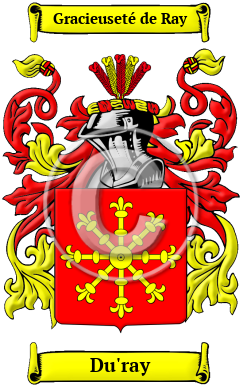
| ![Show Contents]() Du'ray History, Family Crest & Coats of Arms Du'ray History, Family Crest & Coats of Arms
Etymology of Du'rayWhat does the name Du'ray mean? From the historical and enchanting region of France emerged a multitude of noble families, including the distinguished Du'ray family. Originally, the French people were known only by a single name. The process by which hereditary surnames were adopted in France is extremely interesting. Surnames evolved during the Middle Ages when people began to assume an extra name to avoid confusion and to further identify themselves. Often they adopted names that were derived from nicknames. Nickname surnames were derived from an eke-name, or added name. They usually reflected the physical characteristics or attributes of the first person that used the name. The name Du'ray is a nickname type of surname for a person of regal bearing or a person who played a king in a local festival. Looking back further, we find the name Du'ray was derived from the Old French word "roy," meaning "king." Early Origins of the Du'ray familyThe surname Du'ray was first found in Burgundy (French: Bourgogne), an administrative and historical region of east-central France, where the family has held a family seat since ancient times. Early History of the Du'ray familyThis web page shows only a small excerpt of our Du'ray research. Another 148 words (11 lines of text) covering the years 1098, 1306, 1330, 1470, 1533, 1570, 1583, 1645, 1726 and 1803 are included under the topic Early Du'ray History in all our PDF Extended History products and printed products wherever possible. Du'ray Spelling VariationsSpelling variations of this family name include: Ray, Rays, Raie, Raies, Raye, Rayes, Rée, Rées, Rait, Rey, Reys, Rei, Reis, Duray, Leray, De Laray, Laray, du Ray, de Ray, Delurey and many more. Early Notables of the Du'ray familyAnother 49 words (4 lines of text) are included under the topic Early Du'ray Notables in all our PDF Extended History products and printed products wherever possible.
| Du'ray migration to Canada | + |
Du'ray Settlers in Canada in the 17th Century- Mr. Gilles Duray, French settler travelling to Canada for work arriving on 1st April 1665 1
The motto was originally a war cry or slogan. Mottoes first began to be shown with arms in the 14th and 15th centuries, but were not in general use until the 17th century. Thus the oldest coats of arms generally do not include a motto. Mottoes seldom form part of the grant of arms: Under most heraldic authorities, a motto is an optional component of the coat of arms, and can be added to or changed at will; many families have chosen not to display a motto.
Motto: Gracieuseté de Ray
Motto Translation: The graciousness of Ray
- Debien, Gabriel. Liste Des Engagés Pour Le Canada Au XVIIe Siècle. Vol. 6, Laval University, 1952. (Retreived 24th May 2018). Retrieved from https://lebloguedeguyperron.wordpress.com/2016/06/30/130-liste-des-contrats-dengagement-pour-la-nouvelle-france-releves-a-la-rochelle-entre-1634-et-1679/
 |