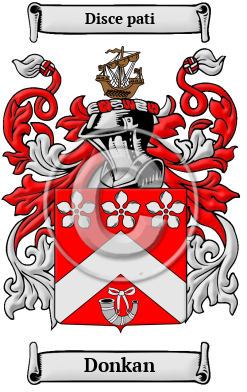
The Hebrides islands and the west coast of Scotland are the ancestral home of the Donkan family. Their name comes from the Gaelic personal name "Donnchad," which means "brown warrior". The personal nameDonnchad is composed of two elements; "donn," which means "brown" and "cath," which means "warrior".
Loading...
Early Origins of the Donkan family
The surname Donkan was first found in Northumberland, where they held great estates but were a branch of the distinguished Scottish Clan of Duncan who were originally of Iona in the Hebrides, but changed their name and continued to use the basic Coat of Arms of the Duncan Clan.
Early History of the Donkan family
This web page shows only a small excerpt of our Donkan research. Another 62 words (4 lines of text) are included under the topic Early Donkan History in all our PDF Extended History products and printed products wherever possible.
Donkan Spelling Variations
Medieval translation of Gaelic names could not be referred to as an accurate process. Spelling was not yet standardized, and names in documents from that era are riddled with spelling variations. Donkan has been written as Donkin, Downkin, Donking, Donken, Downken and others.
Early Notables of the Donkan family
More information is included under the topic Early Donkan Notables in all our PDF Extended History products and printed products wherever possible.
Loading...
Loading...
Loading...
Loading...
Migration of the Donkan family
Ancestors of many of the Dalriadan families who crossed the Atlantic still live along the east coast of the United States and Canada. Some Scottish settlers arrived in Canada during the American War of Independence as United Empire Loyalists, while others stayed south to fight for a new nation. The descendants of Scottish settlers in both countries began to rediscover their heritage in the 19th and 20th centuries through Clan societies and highland games. An inquiry into the early roots of North American families has revealed a number of immigrants bearing the name Donkan or a variant listed above: Patrick Donkin arrived in Pennsylvania in 1820.
The motto was originally a war cry or slogan. Mottoes first began to be shown with arms in the 14th and 15th centuries, but were not in general use until the 17th century. Thus the oldest coats of arms generally do not include a motto. Mottoes seldom form part of the grant of arms: Under most heraldic authorities, a motto is an optional component of the coat of arms, and can be added to or changed at will; many families have chosen not to display a motto.
Motto: Disce pati Motto Translation: Learn to suffer.
Remove Item
WARNING!
Removing this item from your shopping cart will remove your associated sale items.
Are you sure you want to delete this item from your shopping cart?