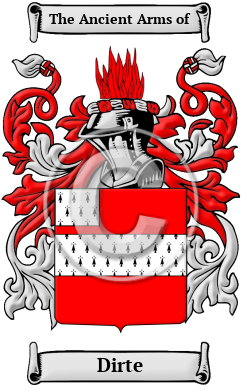
| ![Show Contents]() Dirte History, Family Crest & Coats of Arms Dirte History, Family Crest & Coats of Arms
- Origins Available:
England
Wales
Etymology of DirteWhat does the name Dirte mean? The name Dirte reached English shores for the first time with the ancestors of the Dirte family as they migrated following the Norman Conquest of 1066. The Dirte family lived in Devon, near the river Dart, from which the surname derives. 1 Alternatively, the name could have originated from the Old French word "dart 'a pointed missile thrown by hand', perhaps metonymic for a soldier or a hunter." 2 Early Origins of the Dirte familyThe surname Dirte was first found in Devon where Ralph de Derth was recorded in 1242. A few years later Juhelinus de Derte was recorded in the Hundredorum Rolls for Devon in 1275. The name is from Dart Raffe in Witheridge, Devon. Later again, John Dart was recorded in the Subsidy Rolls for Devon in 1524. In Gloucestershire, Walter Dert was listed in the Assize Rolls for 1221. 2 The family may have given birth to the parish of Dartington, in the union of Totnes, hundred of Stanborough, Stanborough and Coleridge, in Devon, two miles from Totnes 3 which is home to Dartington Manor, an historic hall and country estate of 1,200 acres dating from medieval times. One source claims the manor is "one of the most spectacular surviving domestic buildings of late Medieval England." Today it is the home of the Dartington Trust, which currently runs 16 charitable educational programs, including Schumacher College, Dartington Arts School, Research in Practice and the Dartington International Summer School. Early History of the Dirte familyThis web page shows only a small excerpt of our Dirte research. Another 129 words (9 lines of text) covering the years 1086, 1730, 1817, 1836, 1838, 1841, 1842, 1851, 1852, 1856, 1860, 1862, 1865, 1871, 1875, 1876, 1877, 1885, 1886 and 1887 are included under the topic Early Dirte History in all our PDF Extended History products and printed products wherever possible. Dirte Spelling VariationsAnglo-Norman names tend to be marked by an enormous number of spelling variations. This is largely due to the fact that Old and Middle English lacked any spelling rules when Norman French was introduced in the 11th century. The languages of the English courts at that time were French and Latin. These various languages mixed quite freely in the evolving social milieu. The final element of this mix is that medieval scribes spelled words according to their sounds rather than any definite rules, so a name was often spelled in as many different ways as the number of documents it appeared in. The name was spelled Dart, Darte, Darth and others. Early Notables of the Dirte familyJohn Dart (d. 1730), English antiquary, "bred an attorney, but meeting with little success in that profession, he turned to the church as a means of subsistence. He served the church of Yateley...
Another 32 words (2 lines of text) are included under the topic Early Dirte Notables in all our PDF Extended History products and printed products wherever possible. Migration of the Dirte familyBecause of the political and religious discontent in England, families began to migrate abroad in enormous numbers. Faced with persecution and starvation at home, the open frontiers and generally less oppressive social environment of the New World seemed tantalizing indeed to many English people. The trip was difficult, and not all made it unscathed, but many of those who did get to Canada and the United States made important contributions to the young nations in which they settled. Some of the first North American settlers with Dirte name or one of its variants: Ambrose Dart settled in Boston, Massachusetts about the year 1640; and Richard Dart settled in New London in the year 1664; Jane Dart settled in Bermuda in 1635.
- Lower, Mark Anthony, Patronymica Britannica, A Dictionary of Family Names of the United Kingdom. London: John Russel Smith, 1860. Print.
- Reaney, P.H and R.M. Wilson, A Dictionary of English Surnames. London: Routledge, 1991. Print. (ISBN 0-415-05737-X)
- Lewis, Samuel, A Topographical Dictionary of England. Institute of Historical Research, 1848, Print.
 |