
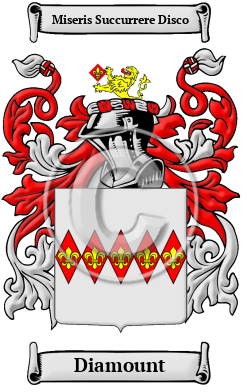
Show ContentsDiamount History, Family Crest & Coats of Arms

Etymology of Diamount

What does the name Diamount mean?

The original Gaelic form of the name Diamount was Ó Diamain. 1

Early Origins of the Diamount family

The surname Diamount was first found in County Londonderry (Irish: Doire), a Northern Irish county also known as Derry, in the province of Ulster, where they held a family seat from very ancient times.

Early History of the Diamount family

This web page shows only a small excerpt of our Diamount research. Another 244 words (17 lines of text) covering the year 1000 is included under the topic Early Diamount History in all our PDF Extended History products and printed products wherever possible.

Diamount Spelling Variations

Irish names were rarely spelled consistently in the Middle Ages. Spelling variations of the name Diamount dating from that time include Diamond, Dymond, Dyment, Diment, Dymott, Dimont and many more.

Early Notables of the Diamount family

More information is included under the topic Early Diamount Notables in all our PDF Extended History products and printed products wherever possible.

Migration of the Diamount family

Thousands of Irish families left for North American shores in the 19th century. These people were searching for a life unencumbered with poverty, hunger, and racial discrimination. Many arrived to eventually find such conditions, but many others simply did not arrive: victims of the diseased, overcrowded ships in which they traveled to the New World. Those who lived to see North American shores were instrumental in the development of the growing nations of Canada and the United States. A thorough examination of passenger and immigration lists has disclosed evidence of many early immigrants of the name Diamount: John Diamond, who settled in Maine in 1620; Robert Dymond brought his family to Barbados in 1634; and Thomas Dyment settled in Virginia in 1635. The family also settled in Newfoundland between 1773 and 1871..


The Diamount Motto +

The motto was originally a war cry or slogan. Mottoes first began to be shown with arms in the 14th and 15th centuries, but were not in general use until the 17th century. Thus the oldest coats of arms generally do not include a motto. Mottoes seldom form part of the grant of arms: Under most heraldic authorities, a motto is an optional component of the coat of arms, and can be added to or changed at will; many families have chosen not to display a motto.

Motto: Miseris Succurrere Disco
Motto Translation: I learn to succour the distressed.


  1. MacLysaght, Edward, The Surnames of Ireland. Ireland: Irish Academic Press, sixth edition, 1985. Print. (ISBN 0-7165-2366-3)


Houseofnames.com on Facebook