| ![Show Contents]() Danport History, Family Crest & Coats of Arms Danport History, Family Crest & Coats of Arms
Etymology of DanportWhat does the name Danport mean? The name Danport reached English shores for the first time with the ancestors of the Danport family as they migrated following the Norman Conquest of 1066. The Danport family lived in the township of Davenport, in the parish of Astbury in East Cheshire. "This place is said to have had a fort, and to have been captured by the Danes about the year 900; but no military remains are now to be seen." 1 The place name literally means "Gateway of the (River) Daven [Old English port, a gate, entrance; Latin porta]." 2 Early Origins of the Danport familyThe surname Danport was first found in Cheshire where they were descended from Ormus de Davenport of Davenport Hall Farm 3 in the parish of Astbury in East Cheshire. "They claim descent in an unbroken line from one Ormus de Davenport, who flourished in the time of the Conqueror." 4 The source Earwaker's East Cheshire lists the following of the family: Orm de Davenport, Cheshire, 1166; and Ralph de Davenport, Cheshire, 1415. "The Davenports claim precedence among the knightly families of Cheshire, - that 'seed-plot of gentry,' 'the mother and the nurse of the gentility of England,' and are traced directly to the Conquest." 5 "The manor [of Marton, Cheshire] was given to an ancestor of the Davenport family, as a dowry with the daughter of Venables, Baron of Kinderton, in the reign of Henry I." 1 Early History of the Danport familyThis web page shows only a small excerpt of our Danport research. Another 186 words (13 lines of text) covering the years 1477, 1503, 1555, 1566, 1574, 1597, 1598, 1623, 1631, 1645, 1670, 1680 and 1794 are included under the topic Early Danport History in all our PDF Extended History products and printed products wherever possible. Danport Spelling VariationsAnglo-Norman names tend to be marked by an enormous number of spelling variations. This is largely due to the fact that Old and Middle English lacked any spelling rules when Norman French was introduced in the 11th century. The languages of the English courts at that time were French and Latin. These various languages mixed quite freely in the evolving social milieu. The final element of this mix is that medieval scribes spelled words according to their sounds rather than any definite rules, so a name was often spelled in as many different ways as the number of documents it appeared in. The name was spelled Davenport, Davenporte, Donarty and others. Early Notables of the Danport familyJohn Davenport (1597-1670), an English Puritan clergyman from Coventry, Warwickshire, co-founder of the American colony of New Haven, eponym of Davenport College, Yale University. 6
Sir Humphrey Davenport of Davenport (1566-1645), was Chief Baron of the Exchequer in 1631; and Francis...
Another 40 words (3 lines of text) are included under the topic Early Danport Notables in all our PDF Extended History products and printed products wherever possible. Migration of the Danport family to IrelandSome of the Danport family moved to Ireland, but this topic is not covered in this excerpt.
Another 34 words (2 lines of text) about their life in Ireland is included in all our PDF Extended History products and printed products wherever possible. Migration of the Danport familyBecause of the political and religious discontent in England, families began to migrate abroad in enormous numbers. Faced with persecution and starvation at home, the open frontiers and generally less oppressive social environment of the New World seemed tantalizing indeed to many English people. The trip was difficult, and not all made it unscathed, but many of those who did get to Canada and the United States made important contributions to the young nations in which they settled. Some of the first North American settlers with Danport name or one of its variants: John Davenport who settled in New Haven, Conn. in 1630; he was first minister there, and an ex Mayor of Coventry, England. Descended from him was William Bales Davenport of Brooklyn. Richard Davenport of Salem, who settled there in 1632. Elizabeth Davenport settled in Boston Massachusetts in 1637.
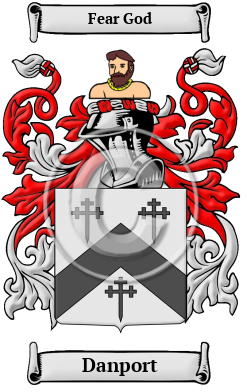
The motto was originally a war cry or slogan. Mottoes first began to be shown with arms in the 14th and 15th centuries, but were not in general use until the 17th century. Thus the oldest coats of arms generally do not include a motto. Mottoes seldom form part of the grant of arms: Under most heraldic authorities, a motto is an optional component of the coat of arms, and can be added to or changed at will; many families have chosen not to display a motto.
Motto: Fear God
- Lewis, Samuel, A Topographical Dictionary of England. Institute of Historical Research, 1848, Print.
- Harrison, Henry, Surnames of the United Kingdom: A Concise Etymological Dictionary Baltimore: Geneological Publishing Company, 2013. Print
- Williams, Dr Ann. And G.H. Martin, Eds., Domesday Book A Complete Translation. London: Penguin, 1992. Print. (ISBN 0-141-00523-8)
- Lower, Mark Anthony, Patronymica Britannica, A Dictionary of Family Names of the United Kingdom. London: John Russel Smith, 1860. Print.
- Shirley, Evelyn Philip, The Noble and Gentle Men of England; The Arms and Descents. Westminster: John Bower Nichols and Sons, 1866, Print.
- Smith, George (ed), Dictionary of National Biography. London: Smith, Elder & Co., 1885-1900. Print
 |