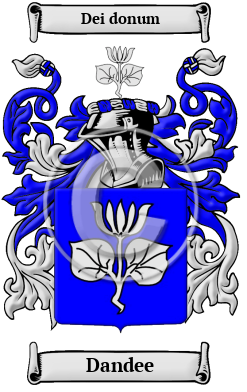
In Scottish history, few names go farther back than Dandee, whose ancestors lived among the clans of the Pictish tribe. They lived in the town of Dundee in Angus.
Loading...
Early Origins of the Dandee family
The surname Dandee was first found in Dundee, in the county of Angus, where they held a family seat from ancient times.
Early History of the Dandee family
This web page shows only a small excerpt of our Dandee research. Another 184 words (13 lines of text) covering the years 1245, 1287, 1292, 1296, 1297, 1458, 1489, 1526 and 1558 are included under the topic Early Dandee History in all our PDF Extended History products and printed products wherever possible.
Dandee Spelling Variations
The arts of spelling and translation were yet in their infancies when surnames began, so there are an enormous number of spelling variations of the names in early Scottish records. This is a particular problem with Scottish names because of the numerous times a name might have been loosely translated to English from Gaelic and back. Dandee has been spelled Dunde, Dundee and others.
Early Notables of the Dandee family
More information is included under the topic Early Dandee Notables in all our PDF Extended History products and printed products wherever possible.
Loading...
Loading...
Loading...
Loading...
Migration of the Dandee family
This oppression forced many Scots to leave their homelands. Most of these chose North America as their destination. Although the journey left many sick and poor, these immigrants were welcomed the hardy with great opportunity. Many of these settlers stood up for their newfound freedom in the American War of Independence. More recently, Scots abroad have recovered much of their collective heritage through highland games and other patriotic functions and groups. An examination of passenger and immigration lists has located various settlers bearing the name Dandee: William Dundee who landed in North America in 1730.
The motto was originally a war cry or slogan. Mottoes first began to be shown with arms in the 14th and 15th centuries, but were not in general use until the 17th century. Thus the oldest coats of arms generally do not include a motto. Mottoes seldom form part of the grant of arms: Under most heraldic authorities, a motto is an optional component of the coat of arms, and can be added to or changed at will; many families have chosen not to display a motto.
Motto: Dei donum Motto Translation: The gift of God.
Remove Item
WARNING!
Removing this item from your shopping cart will remove your associated sale items.
Are you sure you want to delete this item from your shopping cart?