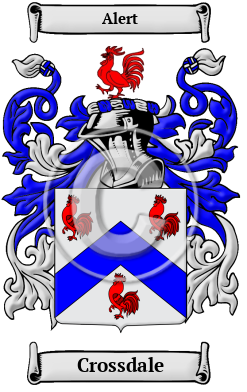
| ![Show Contents]() Crossdale History, Family Crest & Coats of Arms Crossdale History, Family Crest & Coats of Arms
- Origins Available:
England
Etymology of CrossdaleWhat does the name Crossdale mean? The origins of the Crossdale name lie with England's ancient Anglo-Saxon culture. It comes from when the family lived in Crossdale, in the county of Yorkshire. Early Origins of the Crossdale familyThe surname Crossdale was first found in Yorkshire, where the earliest record of the name occurs was of Johannes de Crosdale in 1379 who was listed in the Yorkshire Poll Tax Rolls in 1379. 1 Some of the family held estates at Waddington in the West Riding of Yorkshire since early times. "This place afforded an asylum to the unfortunate monarch Henry VI., who, after the battle of Hexham, was entertained at Waddington Hall, the property of the Croasdale family, and protected by concealment from the pursuit of his enemies for nearly twelve months." 2 There is no doubt that the name is from the Yorkshire/Lancashire borders but the local seems to have been lost over the years. Early History of the Crossdale familyThis web page shows only a small excerpt of our Crossdale research. Another 53 words (4 lines of text) covering the years 1379, 1688, 1737, 1751, 1762, 1768, 1776, 1778, 1782 and 1825 are included under the topic Early Crossdale History in all our PDF Extended History products and printed products wherever possible. Crossdale Spelling VariationsBefore the last few hundred years, the English language had no fast system of spelling rules. For that reason, spelling variations are commonly found in early Anglo-Saxon surnames. Over the years, many variations of the name Crossdale were recorded, including Crossdale, Crosedill, Crosdale, Croasdale, Crossdell, Crosdell, Croasdell and many more. Early Notables of the Crossdale familyJohn Crossdill, born in London in 1751. He received his early musical education in the choir of Westminster Abbey under John Robinson and Benjamin Cooke. Upon quitting the choir he became a performer on the violoncello, and soon attained to considerable proficiency. In 1768 he became a member of the Royal Society of Musicians, and in the following year appeared at Gloucester, as principal violoncello at the meeting of the Three Choirs, a position which he continued to occupy until his retirement from his profession, with the exception of...
Another 89 words (6 lines of text) are included under the topic Early Crossdale Notables in all our PDF Extended History products and printed products wherever possible.
| Crossdale migration to the United States | + |
To escape oppression and starvation at that time, many English families left for the "open frontiers" of the New World with all its perceived opportunities. In droves people migrated to the many British colonies, those in North America in particular, paying high rates for passages in cramped, unsafe ships. Although many of the settlers did not make the long passage alive, those who did see the shores of North America perceived great opportunities before them. Many of the families that came from England went on to make essential contributions to the emerging nations of Canada and the United States. Research into various historical records revealed some of first members of the Crossdale family emigrate to North America:
Crossdale Settlers in United States in the 19th Century- Thomas Crossdale who arrived in Philadelphia in 1866
The motto was originally a war cry or slogan. Mottoes first began to be shown with arms in the 14th and 15th centuries, but were not in general use until the 17th century. Thus the oldest coats of arms generally do not include a motto. Mottoes seldom form part of the grant of arms: Under most heraldic authorities, a motto is an optional component of the coat of arms, and can be added to or changed at will; many families have chosen not to display a motto.
Motto: Alert
- Bardsley, C.W, A Dictionary of English and Welsh Surnames: With Special American Instances. Wiltshire: Heraldry Today, 1901. Print. (ISBN 0-900455-44-6)
- Lewis, Samuel, A Topographical Dictionary of England. Institute of Historical Research, 1848, Print.
 |