
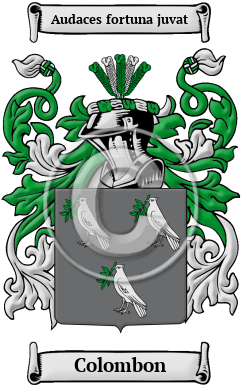
Show ContentsColombon History, Family Crest & Coats of Arms

Etymology of Colombon

What does the name Colombon mean?

Colombon is a name of Anglo-Saxon origin and came from the baptismal name Columbine which means dove. 1

Early Origins of the Colombon family

The surname Colombon was first found in Norfolk, where Peter Colombine, Norwich was recorded in 1739. Later, Paul Columbine was rector of Thurlton, Norfolk. 2

Early History of the Colombon family

This web page shows only a small excerpt of our Colombon research. Another 86 words (6 lines of text) covering the years 1275, 1625, 1708, 1739, 1740 and 1757 are included under the topic Early Colombon History in all our PDF Extended History products and printed products wherever possible.

Colombon Spelling Variations

Spelling variations in names were a common occurrence before English spelling was standardized a few hundred years ago. In the Middle Ages, even the literate spelled their names differently as the English language incorporated elements of French, Latin, and other European languages. Many variations of the name Colombon have been found, including Columbine, Cullumbine, Cullabine, Cullebene, Collenbine, Colombine, Clonbine and many more.

Early Notables of the Colombon family

More information is included under the topic Early Colombon Notables in all our PDF Extended History products and printed products wherever possible.

Migration of the Colombon family

Families began migrating abroad in enormous numbers because of the political and religious discontent in England. Often faced with persecution and starvation in England, the possibilities of the New World attracted many English people. Although the ocean trips took many lives, those who did get to North America were instrumental in building the necessary groundwork for what would become for new powerful nations. Among the first immigrants of the name Colombon, or a variant listed above to cross the Atlantic and come to North America were : Richard Cullumbine who arrived in Virginia in 1635.


The Colombon Motto +

The motto was originally a war cry or slogan. Mottoes first began to be shown with arms in the 14th and 15th centuries, but were not in general use until the 17th century. Thus the oldest coats of arms generally do not include a motto. Mottoes seldom form part of the grant of arms: Under most heraldic authorities, a motto is an optional component of the coat of arms, and can be added to or changed at will; many families have chosen not to display a motto.

Motto: Audaces fortuna juvat
Motto Translation: Fortune favours the bold.


  1. Bardsley, C.W, A Dictionary of English and Welsh Surnames: With Special American Instances. Wiltshire: Heraldry Today, 1901. Print. (ISBN 0-900455-44-6)
  2. Rye, Walter, A History of Norfolk. London: Elliot Stock, 62, Paternoster Row, 1885. Print


Houseofnames.com on Facebook