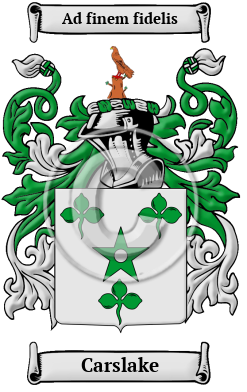
| ![Show Contents]() Carslake History, Family Crest & Coats of Arms Carslake History, Family Crest & Coats of Arms
- Origins Available:
England
Etymology of CarslakeWhat does the name Carslake mean? In ancient Anglo-Saxon England, the ancestors of the Carslake surname lived near a stream in which a substantial quantity of the edible plant cress or watercress grew. The surname Carslake is derived from the Old English words cærse, which means cress, and lacu, which means stream. 1 The surname Carslake belongs to the class of topographic surnames, which were given to people who resided near physical features such as hills, streams, churches, or types of trees. Early Origins of the Carslake familyThe surname Carslake was first found in Devon at Kerslake, a hamlet near Tiverton. "Burgesses of that town bore this name in the reign of James I., and Abraham Kerslake was a Tiverton churchwarden in the time of Charles II." 2 The "C" and "K" prefix for the name has always been interchangeable, as the first record of the family was actually found in Somerset. The Assize Rolls of Somerset in 1279 listed Ranulph de Carselak. 3 Early History of the Carslake familyThis web page shows only a small excerpt of our Carslake research. Another 116 words (8 lines of text) covering the years 1279, 1295, 1586, 1677, 1821 and 1881 are included under the topic Early Carslake History in all our PDF Extended History products and printed products wherever possible. Carslake Spelling VariationsIt is only in the last few hundred years that the English language has been standardized. For that reason, early Anglo-Saxon surnames like Carslake are characterized by many spelling variations. As the English language changed and incorporated elements of other European languages, even literate people changed the spelling of their names. The variations of the name Carslake include: Karslake, Carslake, Kerslake, Carselak, Karslack and others. Early Notables of the Carslake familyMore information is included under the topic Early Carslake Notables in all our PDF Extended History products and printed products wherever possible.
| Carslake migration to the United States | + |
Many English families tired of political and religious strife left Britain for the new colonies in North America. Although the trip itself offered no relief - conditions on the ships were extremely cramped, and many travelers arrived diseased, starving, and destitute - these immigrants believed the opportunities that awaited them were worth the risks. Once in the colonies, many of the families did indeed prosper and, in turn, made significant contributions to the culture and economies of the growing colonies. An inquiry into the early roots of North American families has revealed a number of immigrants bearing the name Carslake or a variant listed above:
Carslake Settlers in United States in the 18th Century- Thomas Carslake journeyed to Boston in 1716
| Carslake migration to Australia | + |
Carslake Settlers in Australia in the 19th Century- Edward B Carslake, who arrived in Adelaide, Australia aboard the ship "Success" in 1848 4
The motto was originally a war cry or slogan. Mottoes first began to be shown with arms in the 14th and 15th centuries, but were not in general use until the 17th century. Thus the oldest coats of arms generally do not include a motto. Mottoes seldom form part of the grant of arms: Under most heraldic authorities, a motto is an optional component of the coat of arms, and can be added to or changed at will; many families have chosen not to display a motto.
Motto: Ad finem fidelis
Motto Translation: Faithful to the end.
- Harrison, Henry, Surnames of the United Kingdom: A Concise Etymological Dictionary Baltimore: Geneological Publishing Company, 2013. Print
- Guppy, Henry Brougham, Homes of Family Names in Great Britain. 1890. Print.
- Reaney, P.H and R.M. Wilson, A Dictionary of English Surnames. London: Routledge, 1991. Print. (ISBN 0-415-05737-X)
- State Records of South Australia. (Retrieved 2010, November 5) SUCCESS 1848. Retrieved from http://www.slsa.sa.gov.au/BSA/1848Success.htm
 |