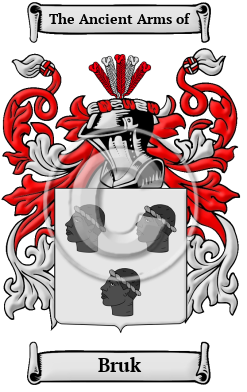
| ![Show Contents]() Bruk History, Family Crest & Coats of Arms Bruk History, Family Crest & Coats of Arms
- Origins Available:
Germany
Etymology of BrukWhat does the name Bruk mean? The history of the Bruk family name begins in the historic German region of Prussia. Bruk is a nickname surname, a class of German names derived from eke-names, or added names, that described people by a personal characteristic or other attribute. Bruk is a name for a near a bridge. The family name Bruk was originally derived from the German word brücke, which in turn was originally derived from the Old German brugga, which means bridge. However, in the Low German regions, the name Bruk stems from the Low German word brauk which means swamp. Alternatively, in the eastern parts of Germany, the surname Bruk originated as a nickname type of surname derived from the Wendish (Slavic) word bruk, which means beetle or bug. Early Origins of the Bruk familyThe surname Bruk was first found in Bavaria, where the name Bruck became noted for its many branches with the region where each house acquired a status and influence which was envied by the princes of the region. One of the first records of the family was Ocko I tom Brok (de Broke) (c. 1345-1389), Chieftain of the Brokmerland and the Auricherland in East Frisia, a former territory on Germany's North Sea coast (1376-1389.) His son, Ocko II tom Brok (1407-1435) was also Chieftain of the Brokmerland and the Auricherland in East Frisia. Early History of the Bruk familyThis web page shows only a small excerpt of our Bruk research. Another 90 words (6 lines of text) covering the years 1500, 1515 and 1554 are included under the topic Early Bruk History in all our PDF Extended History products and printed products wherever possible. Bruk Spelling VariationsMany cultural groups lived in the German states in medieval times. Each had its own dialect and traditions, and unique variations of popular names. Low German, which is similar to contemporary Dutch, was spoken in Westphalia. German names are characterized by additions such as regional suffixes and phrases that tell something about the origin or background of its original bearer. Further contributing to the variation in German names was the fact that there were no spelling rules in medieval times: scribes recorded names according to their sound. The recorded spelling variations of Bruk include Bruch, Brucke, Brukke, Breuck, Breucke, Breuch, Breukk, Brueck, Bruech, Bruecke and many more. Early Notables of the Bruk familyMore information is included under the topic Early Bruk Notables in all our PDF Extended History products and printed products wherever possible. Migration of the Bruk familySince medieval times, the state of Prussia has played an important part in the history of Germany. The state's military powers were historically very strong, and endured until after the Second World War, when the territory was broken up and divided between the Soviet Union, Poland, East Germany and West Germany. A spurt of migration followed, with some Prussians going elsewhere in Europe and many others crossing the ocean to North America. Most entered the United States through Philadelphia. Some remained there, while more moved on to the states of Ohio, Texas, Illinois, California, New York, and Maryland. Others traveled to Canada and settled Ontario and the prairie provinces. Research into the origins of individual families in North America revealed records of the immigration of a number of people bearing the name Bruk or a variant listed above: Magdalena and Friedrich Bruck, who both arrived in Philadelphia in 1776; Jacob and Ludwick Bruck arrived in Somerset County, Pa. in 1838; Elis arrived in Cincinnati, Ohio in 1846.
 |