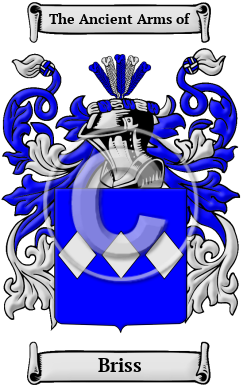
| ![Show Contents]() Briss History, Family Crest & Coats of Arms Briss History, Family Crest & Coats of Arms
- Origins Available:
France
Etymology of BrissWhat does the name Briss mean? The French name Briss originated in the northern coastal region of France known as Normandy. The name Normandy was derived from the settlement and conquest of the territory by ("Northmen") better known as Vikings. Early Origins of the Briss familyThe surname Briss was first found in Normandy (French: Normandie), the former Duchy of Normandy, where the family first originated, maintaining their status as one of the more distinguished families of the region. Robert de Brix, companion to Duke Guillaume, was first registered in the region in 1066. The family later received its title of nobility in 1666. The family continued to prosper and was later cited in Fontenay le Comte in the sub-prefecture of Vendée. Nicolas Brisson was recorded in the region in 1431. Other noteworthy family members include a commander of Rivière (in the region of Touraine) in 1404 and Barnabé Brisson, thought to be the most scholarly of men by King Henry III, he was president of parliament in Paris. 1 Early History of the Briss familyThis web page shows only a small excerpt of our Briss research. Another 52 words (4 lines of text) covering the years 1467, 1531, 1591, 1666, 1810 and 1813 are included under the topic Early Briss History in all our PDF Extended History products and printed products wherever possible. Briss Spelling VariationsChanges of spelling have occurred in most surnames. The earliest explanation is that during the early development of the French language, names were not yet fixed in spelling. Usually a person gave his version of his name, phonetically, to a scribe, a priest, or a recorder. This depended on accent, and local accents frequently changed the spelling of a name. Some variables were adopted by different branches of the family name. Hence, there are some spelling variations of the name Briss, including Brisson, Brison, Brès, Bris, Brix, de Brix, Bresset, Bresson, Bressot, Brice, Brisse, Brisset, Brissonot, Brissonneau, Brissonet, Brissonnet, Brissot, Brissaud and many more. Early Notables of the Briss family- Barnabé Brisson (Latinised: Barnabas Brissonius) (1531-1591) was a French jurist and politician
- Claude Brisson, Knight of the Empire and chief commander, ennobled in 1813
| Briss migration to the United States | + |
Migration from France to New France or Quebec as it was now more popularly called, continued from France until it fell in 1759. By 1675, there were 7000 French in Quebec. By the same year the Acadian presence in Nova Scotia, New Brunswick and Prince Edward Island had reached 500. In the treaty of Utrecht, the Acadians were ceded by France to Britain in 1713. In 1755, 10,000 French Acadians refused to take an oath of allegiance to England and were deported. They found refuge in Louisiana. In 1793, the remaining French in these provinces came under British rule. Meanwhile, in Quebec, the French race flourished, founding in Lower Canada, one of the two great solitudes which became Canada. Many of this distinguished family name Briss were prominent in social, cultural, religious and political affairs in France and New France. Amongst the settlers in North America with this distinguished name Briss were
Briss Settlers in United States in the 19th Century- Johann Briss, aged 32, who arrived in America in 1839 2
| Briss migration to New Zealand | + |
Emigration to New Zealand followed in the footsteps of the European explorers, such as Captain Cook (1769-70): first came sealers, whalers, missionaries, and traders. By 1838, the British New Zealand Company had begun buying land from the Maori tribes, and selling it to settlers, and, after the Treaty of Waitangi in 1840, many British families set out on the arduous six month journey from Britain to Aotearoa to start a new life. Early immigrants include: Briss Settlers in New Zealand in the 19th Century- C. Briss, Scottish settler travelling from Glasgow aboard the ship "Three Bells" arriving in Dunedin, Otago, South Island, New Zealand on 13th July 1858 3
- Hozier, Charles D, and Antoine Bachelin-Delforenne. État présent De La Noblesse française (1883-1887): Contenant Le Distionnaire De La Noblesse Contemporaine Et Larmorial général De France, Dapres Les Manuscrits De Ch. D Hozier. Librairie Des Bibliophiles, 1884. Print.
- Filby, P. William, Meyer, Mary K., Passenger and immigration lists index : a guide to published arrival records of about 500,000 passengers who came to the United States and Canada in the seventeenth, eighteenth, and nineteenth centuries. 1982-1985 Cumulated Supplements in Four Volumes Detroit, Mich. : Gale Research Co., 1985, Print (ISBN 0-8103-1795-8)
- New Zealand Yesteryears Passenger Lists 1800 to 1900 (Retrieved 26th March 2019). Retrieved from http://www.yesteryears.co.nz/shipping/passlist.html
 |