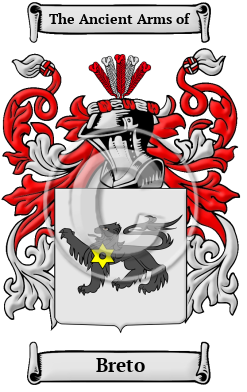
| ![Show Contents]() Breto History, Family Crest & Coats of Arms Breto History, Family Crest & Coats of Arms
Etymology of BretoWhat does the name Breto mean? The name Breto has a long French heritage that first began in northwestern region of Brittany. The name is derived from when the family lived in the province of Brittany, known to the French as Bretagne. Dwellers in this province were referred to as Bretons. Early Origins of the Breto familyThe surname Breto was first found in Brittany, where the family has held a family seat since ancient times. Early History of the Breto familyThis web page shows only a small excerpt of our Breto research. Another 310 words (22 lines of text) covering the years 1558, 1609, 1655, 1679, 1700, 1900 and 1913 are included under the topic Early Breto History in all our PDF Extended History products and printed products wherever possible. Breto Spelling VariationsHistory has changed the spelling of most surnames. During the early development of the French language in the Middle Ages, a person gave his version of his name, phonetically, to a scribe, a priest, or a recorder. Some variables were adopted by different branches of the family name. Hence, there spelling variations of the name Breto, some of which include Breton, Bretone, Bretton, Breto, Bretto, Bret, Bretau, Breteau, Brettau, Bretteau, Bretaux, Brettaux, LeBreton, Lebreteau, Lebreto and many more. Early Notables of the Breto family- Denis LeBreton, Magistrate and Legislator
- Raymond Breton (1609-1679), a French Dominican missionary and linguist among the Caribbean Indians
Migration of the Breto familyFrance finally gave land incentives for 2,000 migrants during the 1700s. Early marriage was encouraged in New France, and youths of 18 took fourteen-year-old girls for their wives. The fur trade was developed and attracted migrants, both noble and commoner from France. 15,000 explorers left Montreal in the late 17th and 18th centuries, leaving French names scattered across the continent. The search for the Northwest passage continued. Migration from France to New France or Quebec, as it was now more popularly called, continued until 1759. By 1675, there were 7000 French in Quebec. By the same year the Acadian presence in Nova Scotia, New Brunswick and Prince Edward Island had reached 500. In the treaty of Utrecht, the Acadians were ceded by France to Britain in 1713. In 1755, 10,000 French Acadians refused to take an oath of allegiance to England and were deported. They found refuge in Louisiana. Meanwhile, in Quebec, the French race flourished, founding in Lower Canada, one of the two great solitudes which became Canada. Many of this distinguished family name Breto were prominent in social, cultural, religious and political affairs in France and New France. Amongst the settlers in North America with this distinguished name Breto were Widow Breton, aged 53; who settled with her son Jean Pierre Breton, aged 17; in Charles Town in 1732; Elizabeth Breton, aged 28; who settled in New York in 1820.
 |