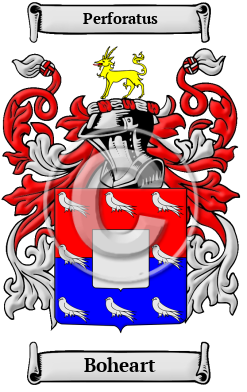
| ![Show Contents]() Boheart History, Family Crest & Coats of Arms Boheart History, Family Crest & Coats of Arms
- Origins Available:
England
Etymology of BoheartWhat does the name Boheart mean? The ancient Anglo-Saxon culture of England produced the name of Boheart. It was given to a dweller at a cottage or small farm. 1 Alternatively, the name could have been derived from the French word "borde," 'a little house, lodging, or cottage of timber, standing alone in the fields. In Domesday [Book] the occupants of cottages are called bordarii, and amount to 82,119 in number." 2 Early Origins of the Boheart familyThe surname Boheart was first found in Sussex, where one of the first records of the family was Andrew Borde or Boorde (1490?-1549), English "traveller and physician, ‘Andreas Parforutus’ as he jocosely calls himself, was born at ‘Boords Hill in Holms dayle,’ near Cuckfield, Sussex, some time before or about 1490, as by 1521 he was appointed suffragan bishop of Chichester, and must have therefore then been thirty years old." 3 Early History of the Boheart familyThis web page shows only a small excerpt of our Boheart research. Another 52 words (4 lines of text) covering the years 1490 and 1549 are included under the topic Early Boheart History in all our PDF Extended History products and printed products wherever possible. Boheart Spelling VariationsOne relatively recent invention that did much to standardize English spelling was the printing press. However, before its invention even the most literate people recorded their names according to sound rather than spelling. The spelling variations under which the name Boheart has appeared include Board, Borde, Bord, Boards and others. Early Notables of the Boheart familyMore information is included under the topic Early Boheart Notables in all our PDF Extended History products and printed products wherever possible. Migration of the Boheart familyAt this time, the shores of the New World beckoned many English families that felt that the social climate in England was oppressive and lacked opportunity for change. Thousands left England at great expense in ships that were overcrowded and full of disease. A great portion of these settlers never survived the journey and even a greater number arrived sick, starving, and without a penny. The survivors, however, were often greeted with greater opportunity than they could have experienced back home. These English settlers made significant contributions to those colonies that would eventually become the United States and Canada. An examination of early immigration records and passenger ship lists revealed that people bearing the name Boheart arrived in North America very early: George Board who settled in Virginia in 1639; Jacob Board settled in Virginia in 1663; John Board settled in Virginia in 1774; Thomas Boards settled in Virginia in 1652..
The motto was originally a war cry or slogan. Mottoes first began to be shown with arms in the 14th and 15th centuries, but were not in general use until the 17th century. Thus the oldest coats of arms generally do not include a motto. Mottoes seldom form part of the grant of arms: Under most heraldic authorities, a motto is an optional component of the coat of arms, and can be added to or changed at will; many families have chosen not to display a motto.
Motto: Perforatus
Motto Translation: Pierce.
- Harrison, Henry, Surnames of the United Kingdom: A Concise Etymological Dictionary Baltimore: Geneological Publishing Company, 2013. Print
- Lower, Mark Anthony, Patronymica Britannica, A Dictionary of Family Names of the United Kingdom. London: John Russel Smith, 1860. Print.
- Smith, George (ed), Dictionary of National Biography. London: Smith, Elder & Co., 1885-1900. Print
 |