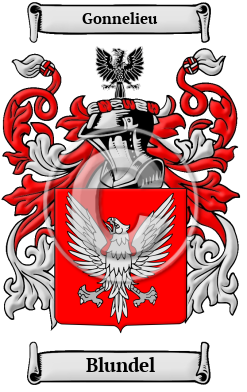
Noble surnames, such as Blundel, evoke images of the ancient homeland of the French people. The original bearer of the name Blundel, which is a local surname, once lived, held land, or was born in the beautiful region of Picardy. In France, hereditary surnames were adopted according to fairly general rules and during the late Middle Ages, names that were derived from localities became increasingly widespread. Local names originally denoted the proprietorship of the village or estate. The Blundel family originally derived its surname from the name of the Seigneury De Landelles, which was in the province of Picardy.
Loading...
Early Origins of the Blundel family
The surname Blundel was first found in Picardy (French: Picardie) in northern France, where they held a family seat in the Seigniory of De Landelles, a village in the department De l'Oise in the arrondisement of Beauvais.
Early History of the Blundel family
This web page shows only a small excerpt of our Blundel research. Another 118 words (8 lines of text) covering the years 1585, 1591, 1617, 1618, 1655, 1672, 1680, 1686 and 1705 are included under the topic Early Blundel History in all our PDF Extended History products and printed products wherever possible.
Blundel Spelling Variations
Spelling variations of this family name include: Blondel, Blondell, Blondelle, Blondeel, Blundel, Blundell, Blundeel, La Blondell and many more.
Early Notables of the Blundel family
Another 37 words (3 lines of text) are included under the topic Early Blundel Notables in all our PDF Extended History products and printed products wherever possible.
Loading...
Loading...
Loading...
Loading...
Migration of the Blundel family
Some of the first settlers of this family name or some of its variants were: Henry Blondel who settled in Louisiana in 1756; John Blondell settled in Maryland in 1716; Thomas Blondell settled in Boston, Massachusetts, in 1716..
The motto was originally a war cry or slogan. Mottoes first began to be shown with arms in the 14th and 15th centuries, but were not in general use until the 17th century. Thus the oldest coats of arms generally do not include a motto. Mottoes seldom form part of the grant of arms: Under most heraldic authorities, a motto is an optional component of the coat of arms, and can be added to or changed at will; many families have chosen not to display a motto.
Motto: Gonnelieu
Remove Item
WARNING!
Removing this item from your shopping cart will remove your associated sale items.
Are you sure you want to delete this item from your shopping cart?