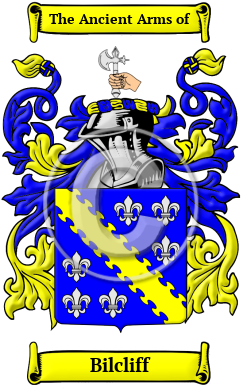
| ![Show Contents]() Bilcliff History, Family Crest & Coats of Arms Bilcliff History, Family Crest & Coats of Arms
- Origins Available:
England
Etymology of BilcliffWhat does the name Bilcliff mean? The history of the Bilcliff family goes back to the ancient Anglo-Saxon culture of Britain. It is derived from the family living in the village of Bilcliff, in the West Riding of the county of Yorkshire. The name of that place is derived from the Old English word bil, which originally referred to a sword or halberd. Early Origins of the Bilcliff familyThe surname Bilcliff was first found in Yorkshire, where one of the first records of the name was Thomas de Billeclyf who was listed there in 1308. Later, John Bilclif was listed in Yorkshire in 1617. 1 A very learned family, the Register of the University of Oxford has two early listings: Thomas Bilclif,1581; and Thomas Bilcliffe, Berkshire, 1615. 2 Early History of the Bilcliff familyThis web page shows only a small excerpt of our Bilcliff research. Another 236 words (17 lines of text) covering the years 1308, 1500, 1615, 1617, 1661, 1663, 1668, 1788 and 1793 are included under the topic Early Bilcliff History in all our PDF Extended History products and printed products wherever possible. Bilcliff Spelling VariationsUntil quite recently, the English language has lacked a definite system of spelling rules. Consequently, Anglo-Saxon surnames are characterized by a multitude of spelling variations. Changes in Anglo-Saxon names were influenced by the evolution of the English language, as it incorporated elements of French, Latin, and other languages. Although Medieval scribes and church officials recorded names as they sounded, so it is common to find one person referred to by several different spellings of his surname, even the most literate people varied the spelling of their own names. Variations of the name Bilcliff include Billcliffe, Bilcliffe, Billcliff, Bilcliff, Billeclyf, Bilclif and many more. Early Notables of the Bilcliff family- Joseph Bilcliffe was a London bookseller located at the Great Piazza, Covent Garden, 1661-16633...
| Bilcliff migration to New Zealand | + |
Emigration to New Zealand followed in the footsteps of the European explorers, such as Captain Cook (1769-70): first came sealers, whalers, missionaries, and traders. By 1838, the British New Zealand Company had begun buying land from the Maori tribes, and selling it to settlers, and, after the Treaty of Waitangi in 1840, many British families set out on the arduous six month journey from Britain to Aotearoa to start a new life. Early immigrants include: Bilcliff Settlers in New Zealand in the 19th Century- Arthur Bilcliff, aged 19, a grocer, who arrived in Wellington, New Zealand aboard the ship "Ionic" in 1884
- Elizabeth Bilcliff, aged 55, a housekeeper, who arrived in Wellington, New Zealand aboard the ship "Ionic" in 1884
- Matilda Bilcliff, aged 28, who arrived in Wellington, New Zealand aboard the ship "Ionic" in 1884
- Zepporah Bilcliff, aged 22, who arrived in Wellington, New Zealand aboard the ship "Ionic" in 1884
- Annie Bilcliff, aged 13, who arrived in Wellington, New Zealand aboard the ship "Ionic" in 1884
- Reaney, P.H and R.M. Wilson, A Dictionary of English Surnames. London: Routledge, 1991. Print. (ISBN 0-415-05737-X)
- Bardsley, C.W, A Dictionary of English and Welsh Surnames: With Special American Instances. Wiltshire: Heraldry Today, 1901. Print. (ISBN 0-900455-44-6)
- Plomer, Henry Robert A Dictionary of the Booksellers and Printers who Were at Work in England, Scotland and Ireland from 1641 to 1667. London: 1910. Digital scan
 |