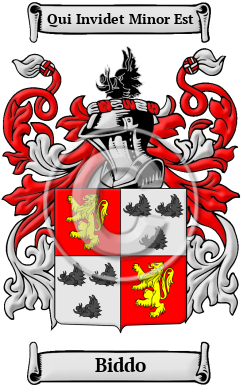
| ![Show Contents]() Biddo History, Family Crest & Coats of Arms Biddo History, Family Crest & Coats of Arms
- Origins Available:
England
Etymology of BiddoWhat does the name Biddo mean? Biddo is a name that dates far back into the mists of early British history to the days of the Anglo-Saxon tribes. It is derived from the Welsh name ap-Eddow meaning son of Eddow. 1 Over time, this has changed to be known as Biddo. Early Origins of the Biddo familyThe surname Biddo was first found in Shropshire where one of the first records of the family was Bedo ap Richard, recorded in 1493. Later, Johanna Bedowe (1577) and John Beddoe (1641) were recorded. 2 Early History of the Biddo familyThis web page shows only a small excerpt of our Biddo research. Another 127 words (9 lines of text) covering the years 1577, 1578, 1621, 1650, 1674 and 1680 are included under the topic Early Biddo History in all our PDF Extended History products and printed products wherever possible. Biddo Spelling VariationsIt is only in the last few hundred years that the English language has been standardized. For that reason, early Anglo-Saxon surnames like Biddo are characterized by many spelling variations. As the English language changed and incorporated elements of other European languages, even literate people changed the spelling of their names. The variations of the name Biddo include: Beddow, Beddoe, Bedoe, Bedow, Bedows, Bedlow and many more. Early Notables of the Biddo familyWilliam Bedloe (1650-1680), "dishonest adventurer and 'evidence' in the Popish plot, was born on 20 April 1650, at midday, at Chepstow. We must receive with doubt whatever he reported of his family, his boastfulness and unveracity being notorious; but he 'always kept a diary of his most remarkable adventures for the space of ten years together, which was the duration of the scene in...
Another 64 words (5 lines of text) are included under the topic Early Biddo Notables in all our PDF Extended History products and printed products wherever possible.
| Biddo migration to the United States | + |
Many English families tired of political and religious strife left Britain for the new colonies in North America. Although the trip itself offered no relief - conditions on the ships were extremely cramped, and many travelers arrived diseased, starving, and destitute - these immigrants believed the opportunities that awaited them were worth the risks. Once in the colonies, many of the families did indeed prosper and, in turn, made significant contributions to the culture and economies of the growing colonies. An inquiry into the early roots of North American families has revealed a number of immigrants bearing the name Biddo or a variant listed above:
Biddo Settlers in United States in the 17th Century- Christopher Biddo, who arrived in Virginia in 1650 3
The motto was originally a war cry or slogan. Mottoes first began to be shown with arms in the 14th and 15th centuries, but were not in general use until the 17th century. Thus the oldest coats of arms generally do not include a motto. Mottoes seldom form part of the grant of arms: Under most heraldic authorities, a motto is an optional component of the coat of arms, and can be added to or changed at will; many families have chosen not to display a motto.
Motto: Qui Invidet Minor Est
Motto Translation: He who envies is inferior
- Bardsley, C.W, A Dictionary of English and Welsh Surnames: With Special American Instances. Wiltshire: Heraldry Today, 1901. Print. (ISBN 0-900455-44-6)
- Reaney, P.H and R.M. Wilson, A Dictionary of English Surnames. London: Routledge, 1991. Print. (ISBN 0-415-05737-X)
- Filby, P. William, Meyer, Mary K., Passenger and immigration lists index : a guide to published arrival records of about 500,000 passengers who came to the United States and Canada in the seventeenth, eighteenth, and nineteenth centuries. 1982-1985 Cumulated Supplements in Four Volumes Detroit, Mich. : Gale Research Co., 1985, Print (ISBN 0-8103-1795-8)
 |