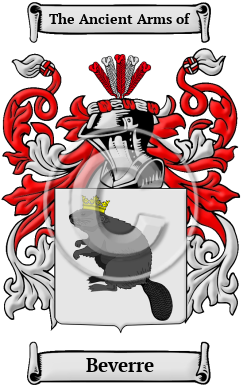
| ![Show Contents]() Beverre History, Family Crest & Coats of Arms Beverre History, Family Crest & Coats of Arms
- Origins Available:
Germany
Etymology of BeverreWhat does the name Beverre mean? In the ancient German province of Westphalia, the surname Beverre evolved. It is a nickname, a style of hereditary surname that developed out of the traditional German eke-names, that identified people by naming them after a physical characteristic or other identifiable trait. Beverre is a name for a beautiful person having derived from the Old French words beu and bel, which mean fair or lovely, and veir or voir, which mean to see. In the 8th and 9th centuries, the French language was commonly spoken in the German states. While the court of Charlemagne (742-814) was Latin-speaking, Frankish dialects of Old German and Old French were still quite commonly used. Early Origins of the Beverre familyThe surname Beverre was first found in Westphalia, where the name was closely identified in early mediaeval times with the feudal society which would become prominent throughout European history. The family originated in the county of Dassel (princedom of Goettingen). The name would later emerge as a noble family with great influence, having many distinguished branches, and become noted for its involvement in social, economic and political affairs. The founding father of the many succeeding branches of the family is usually taken to be Clemens von Bevern, who lived around 903 A.D. The ancestral seat of the family is often taken to be the manor Bevern located in the Warendorf district of Muenster, which the family acquired in 1134. Other chronicles suggest that Clemens von Bevern founded the castle Bevern in the Holzminden district of the duchy of Brunswick, and that this is the true ancestral seat. Early History of the Beverre familyThis web page shows only a small excerpt of our Beverre research. Another 130 words (9 lines of text) covering the years 1107, 1679, 1700, 1732 and 1833 are included under the topic Early Beverre History in all our PDF Extended History products and printed products wherever possible. Beverre Spelling VariationsMany cultural groups lived in the German states in medieval times. Each had its own dialect and traditions, and unique variations of popular names. Low German, which is similar to contemporary Dutch, was spoken in Westphalia. German names are characterized by additions such as regional suffixes and phrases that tell something about the origin or background of its original bearer. Further contributing to the variation in German names was the fact that there were no spelling rules in medieval times: scribes recorded names according to their sound. The recorded spelling variations of Beverre include Bever, Bewer, Bevver, Beverr, Bevere, Beverre, Bevers, Bevvers, Bevvere, Bevern and many more. Early Notables of the Beverre familyJohann Gottfried von Beveren, who became an imperial knight in 1679. The Baron Ernst von Bevern was a Canon and scholar in Osnabrueck in 1700, the Baron Hermann von Bevern served as a...
Another 33 words (2 lines of text) are included under the topic Early Beverre Notables in all our PDF Extended History products and printed products wherever possible. Migration of the Beverre familyAfter 1650, thousands of German settlers came to North America to escape the religious persecution and poverty that wracked Europe and to make the most of the opportunity to own their own land in a new country. They settled across the United States in Pennsylvania, Texas, New York, Illinois, and California, and in Canada in Ontario and on the fertile plains of the prairie provinces. Among them: Isack Bever, age 24, who settled in Virginia in 1635; Jacob Bever arrived in Philadelphia, Pa. in 1732; Peter Bevere came to Philadelphia in 1806.
 |