| ![Show Contents]() Bament History, Family Crest & Coats of Arms Bament History, Family Crest & Coats of Arms
- Origins Available:
Scotland
Etymology of BamentWhat does the name Bament mean? The saga of the Bament family begins among the people of the ancient tribe of the Picts. They lived in the old lands of Balmanno in Kincardine. The name is a topographic or local surname, which was given to a family who held a barony or lands, had houses, manors or estates in the area. Early Origins of the Bament familyThe surname Bament was first found in the parish of Maryldrk, Kincardineshire where Huwe de Balmenaghe of the county of Perth rendered homage in 1296. "The horse of Adam de Balmanaghe is mentioned in 1312, Robert Balmanauch was bailie and burgess of Karale in 1361, the land of Gilbert de Balmanow in Crale is mentioned in 1421, and Robert de Balmannoch is mentioned in a case between the abbeys of Arnbroath and Balmerino in 1459." 1 Early History of the Bament familyThis web page shows only a small excerpt of our Bament research. Another 143 words (10 lines of text) covering the years 1447, 1470, 1473, 1491, 1495, 1534, 1556, 1582, 1589, 1627 and 1684 are included under the topic Early Bament History in all our PDF Extended History products and printed products wherever possible. Bament Spelling VariationsAlthough Medieval Scotland lacked a basic set of spelling rules, which meant that scribes recorded names according to their sounds it was not uncommon for the names of a father and son to be recorded differently. As a result, there are many spelling variations of Scottish single names. Bament has been written Balmano, Belmano, Belmanno, Bolmano, Ballmanno and many more. Early Notables of the Bament familyJohn Belleman or Belmain was, according to Fuller, the French tutor of Edward VI. "The prince appears to have commenced his studies under his instructor in his seventh year (1534). Belleman seems, however, to have been retained in the royal service till the close of...
Another 44 words (3 lines of text) are included under the topic Early Bament Notables in all our PDF Extended History products and printed products wherever possible.
| Bament migration to Australia | + |
Bament Settlers in Australia in the 19th Century- George Bament, aged 21, a farm servant, who arrived in South Australia in 1851 aboard the ship "Lysander" 2
- William Bament, aged 25, a farm servant, who arrived in South Australia in 1851 aboard the ship "Lysander" 2
- William Bament, aged 25, who arrived in Adelaide, Australia aboard the ship "Lysander" in 1851 2
- George Bament, aged 21, who arrived in Adelaide, Australia aboard the ship "Lysander" in 1851 2
| Contemporary Notables of the name Bament (post 1700) | + |
- John Bament, Australian State Director for Northern Territory, Australian Mathematics Competition
- Wendy Bament, British veterinary nurse at The Royal (Dick) School of Veterinary Studies, the University of Edinburgh
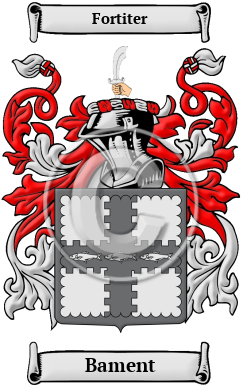
The motto was originally a war cry or slogan. Mottoes first began to be shown with arms in the 14th and 15th centuries, but were not in general use until the 17th century. Thus the oldest coats of arms generally do not include a motto. Mottoes seldom form part of the grant of arms: Under most heraldic authorities, a motto is an optional component of the coat of arms, and can be added to or changed at will; many families have chosen not to display a motto.
Motto: Fortiter
Motto Translation: Strongly (bravely)
- Black, George F., The Surnames of Scotland Their Origin, Meaning and History. New York: New York Public Library, 1946. Print. (ISBN 0-87104-172-3)
- State Records of South Australia. (Retrieved 2010, November 5) LYSANDER 1851. Retrieved http://www.slsa.sa.gov.au/BSA/1851Lysander.htm
 |