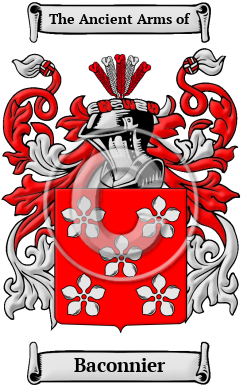
| ![Show Contents]() Baconnier History, Family Crest & Coats of Arms Baconnier History, Family Crest & Coats of Arms
- Origins Available:
France
Etymology of BaconnierWhat does the name Baconnier mean? The Medieval culture once found in the northern region of France known as Normandy, is the soil from which the many generations of the Baconnier family have grown. The name Baconnier was given to a member of the family who was a pig farmer or pork butcher, as the name Baconnier was originally derived from the Old French word "bacun", which meant "pork". 1 Early Origins of the Baconnier familyThe surname Baconnier was first found in Normandy (French: Normandie), the former Duchy of Normandy. The name officially started in Canada with Gilles Bacon, son of Etienne Bacon and Madeleine Féron, who married in Quebec in 1647. 2 Early History of the Baconnier familyThis web page shows only a small excerpt of our Baconnier research. Another 75 words (5 lines of text) covering the years 1423, 1586, 1731, 1790 and 1795 are included under the topic Early Baconnier History in all our PDF Extended History products and printed products wherever possible. Baconnier Spelling VariationsHistory has changed the spelling of most surnames. During the early development of the French language in the Middle Ages, a person gave his version of his name, phonetically, to a scribe, a priest, or a recorder. Some variables were adopted by different branches of the family name. Hence, there spelling variations of the name Baconnier, some of which include Bacon, Bacou, Baconnier, Bacot, Bacquart, Baconet and many more. Early Notables of the Baconnier familya Bacon who was a Huguenot captain, recorded at his death in 1586. Jean-Jacques Bacon de la Chevalerie, born in 1731, was a brigadier. Luc-Joseph Bacon was named president of the municipal administration of Hersin...
Another 34 words (2 lines of text) are included under the topic Early Baconnier Notables in all our PDF Extended History products and printed products wherever possible. Migration of the Baconnier familyFrench settlers came early to North American, following in the wake of the explorers, and creating New France. Quebec City, founded in 1608 by Samuel de Champlain is said to have been the first American site founded as a permanent settlement, rather than as just a commercial outpost. But emigration was slow, in 1643, 109 years after the first landings by Cartier, there were only about 300 French people in Quebec, and by 1663, when the region was officially made The Royal Colony of New France, by Louis XIV, there still only around 500 settlers. Over 2,000 would arrive during the next decade. Early marriage was desperately encouraged amongst the immigrants. Youths of 18 took fourteen-year-old girls for their wives. The fur trade was developed and attracted immigrants, both noble and commoner from France. By 1675, there were around 7000 French in the colony, and by that same year the Acadian presence in Nova Scotia, New Brunswick and Prince Edward Island had reached 500. In 1755, 10,000 French Acadians refused to take an oath of allegiance to England and were deported to Louisiana. Despite the loss of the Colony to England, the French people flourished in Lower Canada. Among settlers to North America of the Baconnier surname were 180 individuals who arrived from France onto Canadain shores between 1600 and 1900. The first Canadian family of this lineage was originally from the region of Caen, and settled in Canada with Gilles Bacon, who was the son of Etienne and Madeleine Fé.
- Dionne, N.-E., Origine Des Familles Canadiennes-Français. Baltimore: Genealogical Publishing Company, 1969. Print.
- Hozier, Charles D, and Antoine Bachelin-Delforenne. État présent De La Noblesse française (1883-1887): Contenant Le Distionnaire De La Noblesse Contemporaine Et Larmorial général De France, Dapres Les Manuscrits De Ch. D Hozier. Librairie Des Bibliophiles, 1884. Print.
 |