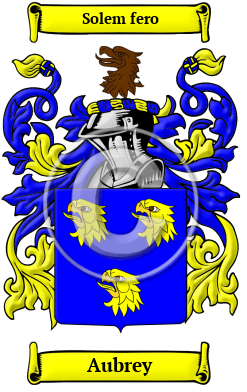
| ![Show Contents]() Aubrey History, Family Crest & Coats of Arms Aubrey History, Family Crest & Coats of Arms
- Origins Available:
England
Etymology of AubreyWhat does the name Aubrey mean? The name Aubrey was brought to England in the great wave of migration following the Norman Conquest of 1066. The Aubrey family lived in Brecknock, Wales, where Sir Reginald Aubrey was granted lands in 1088. The name is topographic in origin and indicates that its original bearer once lived in a place planted with elder trees. The name also may be derived from a batismal name meaning "the son of Aubrey." In this case, the name would have been Albreda in the feminine form and Aubrey in the masculine form. Early Origins of the Aubrey familyThe surname Aubrey was first found in Brecknock in Wales where Sir Reginald Aubrey was granted lands in 1189. According to historians the first records was of "Saint Aubrey of the blood royal of France". Early History of the Aubrey familyThis web page shows only a small excerpt of our Aubrey research. Another 110 words (8 lines of text) covering the years 1189, 1273, 1379, 1500, 1529, 1553, 1559, 1595, 1606, 1626, 1650, 1679, 1680, 1685, 1697, 1698, 1700 and 1743 are included under the topic Early Aubrey History in all our PDF Extended History products and printed products wherever possible. Aubrey Spelling VariationsEndless spelling variations are a prevailing characteristic of Norman surnames. Old and Middle English lacked any definite spelling rules, and the introduction of Norman French added an unfamiliar ingredient to the English linguistic stew. French and Latin, the languages of the court, also influenced spellings. Finally, Medieval scribes generally spelled words according to how they sounded, so one person was often referred to by different spellings in different documents. The name has been spelled Aubrey, Aubry, Aubrie, Aubery, Awbrey, Awbry and others. Early Notables of the Aubrey family- Sir Reginald Aubrey
- William Aubrey (ca. 1529-1595), Regius Professor of Civil Law at the University of Oxford from 1553 to 1559, one of the founding Fellows of Jesus College, Oxford
- Sir John Aubrey, 1st Baronet of Llantrithead in the County of Glamorgan (c. 1606-1679)
- Sir John Aubrey, 2nd Baronet (c. 1650-1700), Member of Parliament for Brackley (1698-1700), High Sheriff of Glamorganshire in 1685
- Sir John Aubrey, 3rd Baronet (1680-1743)
- John Aubrey FRS, (1626-1697), an English antiquary, natural philosopher and writer, best known as the author of the collection of short biographical pieces usually referred to as Brief Lives
Aubrey Rankingthe United States, the name Aubrey is the 8,009th most popular surname with an estimated 2,487 people with that name. 1
| Aubrey migration to Australia | + |
Aubrey Settlers in Australia in the 19th Century- Mr. Charles Aubrey, English convict who was convicted in Banbury, Oxfordshire, England for 7 years, transported aboard the "Eden" on 30th September 1848, arriving in Tasmania (Van Diemen's Island) 2
| Aubrey migration to New Zealand | + |
Emigration to New Zealand followed in the footsteps of the European explorers, such as Captain Cook (1769-70): first came sealers, whalers, missionaries, and traders. By 1838, the British New Zealand Company had begun buying land from the Maori tribes, and selling it to settlers, and, after the Treaty of Waitangi in 1840, many British families set out on the arduous six month journey from Britain to Aotearoa to start a new life. Early immigrants include: Aubrey Settlers in New Zealand in the 19th Century- C Aubrey, who landed in Wellington/New Plymouth, New Zealand in 1840 aboard the ship Essex
- Harcourt Richard Aubrey, aged 22, who arrived in Wellington, New Zealand aboard the ship "London" in 1840
- A Aubrey, who landed in Wellington/New Plymouth, New Zealand in 1842 aboard the ship Essex
| Contemporary Notables of the name Aubrey (post 1700) | + |
- Stuart Neil Aubrey (b. 1990), Australian politician and former electrician
- Rex Aubrey (1935-2021), Australian gold and bronze medalist freestyle swimmer
- Juliet Emma Aubrey (b. 1966), English actress, best known for her role as the antagonist Helen Cutter during the first three seasons of Primeval (2007–2009 and 2011)
- Sir John Aubrey (1707-1767), 4th Baronet
- Sir Thomas Digby Aubrey (1782-1856), 7th Baronet, High Sheriff of Buckinghamshire
- Sir Thomas Aubrey (b. 1786), 5th Baronet
- James Aubrey (1947-2010), born James Aubrey Tregidgo, Austrian-born, English stage and screen actor
- Jimmy Aubrey (1887-1983), English actor who appeared in 419 films and worked with both Charlie Chaplin and Laurel & Hardy
- Brandon Aubrey (b. 1995), American multi-sport athlete who plays as a placekicker
- ... (Another 14 notables are available in all our PDF Extended History products and printed products wherever possible.)
The motto was originally a war cry or slogan. Mottoes first began to be shown with arms in the 14th and 15th centuries, but were not in general use until the 17th century. Thus the oldest coats of arms generally do not include a motto. Mottoes seldom form part of the grant of arms: Under most heraldic authorities, a motto is an optional component of the coat of arms, and can be added to or changed at will; many families have chosen not to display a motto.
Motto: Solem fero
Motto Translation: I bear the sun.
- "What are the 5,000 Most Common Last Names in the U.S.?". NameCensus.com, https://namecensus.com/last-names/
- Convict Records Voyages to Australia (Retrieved 15th November 2021). Retrieved from https://convictrecords.com.au/ships/eden
 |