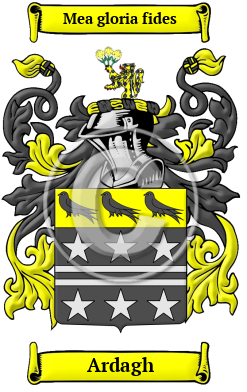
| ![Show Contents]() Ardagh History, Family Crest & Coats of Arms Ardagh History, Family Crest & Coats of Arms
- Origins Available:
Ireland
Etymology of ArdaghWhat does the name Ardagh mean? The surname Ardagh is toponymic in origin, belonging to a small number of Irish surnames which are drawn from place names. The place name Ardagh belongs to parishes in five different counties, as well as to the diocese of Ardagh and Clonmacnois. The Ardagh Chalice was discovered in 1868 in Reevassta Fort, in a place called Ardagh, three miles north of Newcastle West. Early Origins of the Ardagh familyThe surname Ardagh was first found in County Louth (Irish: Lú) the smallest county in Ireland, located on the East coast, in the Province of Leinster, where Richard (de) Ardagh was a juror in 1299. Later mentions of the surname are of John Ardagh, a chaplain in the diocese of Armagh in the 15th century, Walter Ardagh, an archer at Mellifont in 1434, and Robert Ardagh a priest in Disert, County Louth in 1541. Early History of the Ardagh familyThis web page shows only a small excerpt of our Ardagh research. Another 52 words (4 lines of text) covering the years 1803, 1840, 1850, 1869 and 1907 are included under the topic Early Ardagh History in all our PDF Extended History products and printed products wherever possible. Ardagh Spelling VariationsSpelling variations of this family name include: Ardagh, de Ardagh and others. Early Notables of the Ardagh family- Samuel Ardagh (1803-1869), from County Waterford, who was well-known and influential in Canada...
- General Sir John Charles Ardagh (1840-1907), also from County Waterford, distinguished himself in the British Service in India...
| Ardagh migration to Canada | + |
Ardagh Settlers in Canada in the 19th Century- Arthur and William Ardagh, who were both recorded in the 1871 census in Toronto, Ontario
| Ardagh migration to Australia | + |
Ardagh Settlers in Australia in the 19th Century- Marchant Ardagh, who arrived in Adelaide, Australia aboard the ship "Baboo" in 1840 1
- Arthur Ardagh, who arrived in Adelaide, Australia aboard the ship "Lord Ashburton" in 1850 2
| Contemporary Notables of the name Ardagh (post 1700) | + |
- Seán Ardagh (b. 1947), Irish politician
- Philip Ardagh (b. 1961), British children's author whose works have been translated into ten different languages
- William Davis Ardagh (1828-1893), Irish-born Canadian lawyer and politician
- Arjuna Ardagh, British-born, American based speaker and author
- John Ardagh (b. 1928), British journalist and author
The motto was originally a war cry or slogan. Mottoes first began to be shown with arms in the 14th and 15th centuries, but were not in general use until the 17th century. Thus the oldest coats of arms generally do not include a motto. Mottoes seldom form part of the grant of arms: Under most heraldic authorities, a motto is an optional component of the coat of arms, and can be added to or changed at will; many families have chosen not to display a motto.
Motto: Mea gloria fides
Motto Translation: Mea gloria fides.
- State Records of South Australia. (Retrieved 2010, November 5) BABOO 1840. Retrieved from http://www.slsa.sa.gov.au/BSA/1840Baboo.htm
- State Records of South Australia. (Retrieved 2010, November 5) LORD ASHBURTON 1850. Retrieved from http://www.slsa.sa.gov.au/BSA/1850LordAshburton.gif
 |