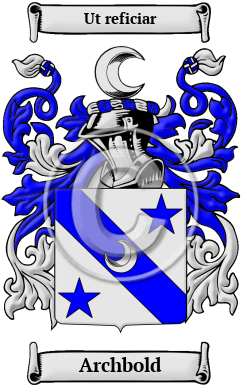
| ![Show Contents]() Archbold History, Family Crest & Coats of Arms Archbold History, Family Crest & Coats of Arms
Etymology of ArchboldWhat does the name Archbold mean? The story of the name Archbold is long and rich in history. It begins among the Boernicians of the Scottish/English Borderlands, where the name was derived from the personal name Arcebold or Arcenbald which means "right bold", "precious bold" or "holy prince". 1 'So frequent was it (Archibald) in the houses of Campbell and Douglas, that, with its contractions of Archie and Baldie, it has become one of the most commonly used in Scotland, recalling many a fierce worthy, from old Archibald Bell-the Cat downwards.' 2 Early Origins of the Archbold familyThe surname Archbold was first found in Roxburghshire, about 30 miles southeast of Edinburgh. They had been settled from very ancient times in the Kelso area. Before the name became a surname, there was mention of an "Achebaldus filius Swani de Forgrunde," during the reign of King William, the Lion, of Scotland (1143-1214). 1 "Thomas, the brother of Erkenbaldus, witnessed the gift of the church of Kilmaurs to the Abbey of Kelso before 1189 and Arkembaldus de Duffus was witness to an agreement between the bishop of Moray and John Byseth concerning the churches of Coneway and Dulbatelauch between 1203-1234. Robert Archebalde had a charter of the Hospital of Roxburgh in 1390 from Robert III and John Archibald was a witness in St. Andrews in 1545." 1 Early History of the Archbold familyThis web page shows only a small excerpt of our Archbold research. Another 92 words (7 lines of text) covering the years 1390, 1545, 1650, 1785, 1822, 1870 and 1890 are included under the topic Early Archbold History in all our PDF Extended History products and printed products wherever possible. Archbold Spelling VariationsIn the Middles Ages scribes spelled names by their sound. Often a name was written under a different spelling variation each time it was recorded. Archbold has appeared as Archbold, Archbald, Archibaldson, Archibald, Archibold, Harchbald, Arkanbaldus, Archebald and many more. Early Notables of the Archbold family- John Frederick Archbold (1785-1870) lawyer and prolific author of legal textbooks...
Migration of the Archbold family to IrelandSome of the Archbold family moved to Ireland, but this topic is not covered in this excerpt.
Another 75 words (5 lines of text) about their life in Ireland is included in all our PDF Extended History products and printed products wherever possible.
| Archbold migration to the United States | + |
The ancestors of Boernician-Scottish settlers dot North America even today. They settled all along the east coast when they came over, but some went north as United Empire Loyalists at the time of the War of Independence. However, these strong lines endured as Scottish families in the United States and Canada have rediscovered much of the heritage that was taken from them centuries ago. Some of the first immigrants to cross the Atlantic and come to North America carried the name Archbold, or a variant listed above:
Archbold Settlers in United States in the 17th Century- George Archbold, who arrived in Maryland in 1675 3
Archbold Settlers in United States in the 20th Century- Helen Archbold, aged 30, who landed in America, in 1906
- Bella Archbold, aged 32, who landed in America from London, England, in 1907
- Elizabeth Archbold, aged 60, who immigrated to the United States, in 1910
- Annie Archbold, aged 22, who landed in America from Dublin, Ireland, in 1911
- James Archbold, aged 29, who settled in America from Tullow, Ireland, in 1912
- ... (More are available in all our PDF Extended History products and printed products wherever possible.)
| Archbold migration to Australia | + |
Archbold Settlers in Australia in the 19th Century- Mr. John Archbold, (Archibald), (b. 1816), aged 20, English soldier from York who was convicted in Cork, Ireland for 7 years for stealing, transported aboard the "Captain Cook" on 5th July 1836, arriving in New South Wales, Australia 4
- Bridget Archbold, aged 25, a servant, who arrived in South Australia in 1850 aboard the ship "Joseph Soames" 5
- Bridget Archbold, aged 25, a servant, who arrived in Adelaide, Australia aboard the ship "Joseph Somes" in 1850 6
| Archbold migration to New Zealand | + |
Emigration to New Zealand followed in the footsteps of the European explorers, such as Captain Cook (1769-70): first came sealers, whalers, missionaries, and traders. By 1838, the British New Zealand Company had begun buying land from the Maori tribes, and selling it to settlers, and, after the Treaty of Waitangi in 1840, many British families set out on the arduous six month journey from Britain to Aotearoa to start a new life. Early immigrants include: Archbold Settlers in New Zealand in the 19th Century- Mr. Archbold, British settler travelling from London aboard the ship 'Melpomene' arriving in Dunedin, Otago, South Island, New Zealand on 26th August 1856 7
- Thomas Archbold, aged 59, a carpenter, who arrived in Auckland, New Zealand aboard the ship "Rooparell" in 1874
- Esther C. Archbold, aged 27, who arrived in Auckland, New Zealand aboard the ship "Rooparell" in 1874
- William Archbold, aged 1, who arrived in Auckland, New Zealand aboard the ship "Rooparell" in 1874
- Catherine Archbold, aged 18, a domestic servant, who arrived in Auckland, New Zealand aboard the ship "Rooparell" in 1874
| Archbold migration to West Indies | + |
The British first settled the British West Indies around 1604. They made many attempts but failed in some to establish settlements on the Islands including Saint Lucia and Grenada. By 1627 they had managed to establish settlements on St. Kitts (St. Christopher) and Barbados, but by 1641 the Spanish had moved in and destroyed some of these including those at Providence Island. The British continued to expand the settlements including setting the First Federation in the British West Indies by 1674; some of the islands include Barbados, Bermuda, Cayman Island, Turks and Caicos, Jamaica and Belize then known as British Honduras. By the 1960's many of the islands became independent after the West Indies Federation which existed from 1958 to 1962 failed due to internal political conflicts. After this a number of Eastern Caribbean islands formed a free association. 8Archbold Settlers in West Indies in the 17th Century- Tho Archbold, aged 19, who landed in St Christopher in 1635 3
- Mr. Thomas Archbold, (b. 1616), aged 19, British settler traveling aboard the ship "William and John" arriving in St Christopher (Saint Kitts) in 1635 9
| Contemporary Notables of the name Archbold (post 1700) | + |
- Ralph Archbold, American contemporary speaker, best known for his impersonation of U.S. Founding Father Benjamin Franklin; in character he was present at the reopening of the Franklin Museum in Philadelphia
- Richard Archbold (1907-1976), American zoologist and philanthropist, grandson of the John Dustin Archbold, eponym of Archbold's bowerbird
- John Dustin Archbold (1848-1916), American business magnet, one of the United States' earliest oil refiners; his small oil company was bought out by John D Rockefeller's Standard Oil Company
- Patrick Archbold (1725-1803), American Revolutionary War Patriot
- John Frederick Archbold (1785-1870), Irish lawyer, known for his work "Summary of the Law relative to Pleading and Evidence in Criminal Cases" (1824)
- Shane William Archbold (b. 1989), New Zealand professional racing cyclist
- Sir Herbert Archbold Brechin, Scottish Knight, Lord Provost of the City of Edinburgh, and Lord Lieutenant, County of the City of Edinburgh
| Historic Events for the Archbold family | + |
- Thomas Cuthbertson Archbold, British Lieutenant Engineer aboard the HMS Cornwall (1942) when she was struck by air bombers and sunk; he survived the sinking 10
The motto was originally a war cry or slogan. Mottoes first began to be shown with arms in the 14th and 15th centuries, but were not in general use until the 17th century. Thus the oldest coats of arms generally do not include a motto. Mottoes seldom form part of the grant of arms: Under most heraldic authorities, a motto is an optional component of the coat of arms, and can be added to or changed at will; many families have chosen not to display a motto.
Motto: Ut reficiar
Motto Translation: That I may be replenished.
- Black, George F., The Surnames of Scotland Their Origin, Meaning and History. New York: New York Public Library, 1946. Print. (ISBN 0-87104-172-3)
- Bardsley, C.W, A Dictionary of English and Welsh Surnames: With Special American Instances. Wiltshire: Heraldry Today, 1901. Print. (ISBN 0-900455-44-6)
- Filby, P. William, Meyer, Mary K., Passenger and immigration lists index : a guide to published arrival records of about 500,000 passengers who came to the United States and Canada in the seventeenth, eighteenth, and nineteenth centuries. 1982-1985 Cumulated Supplements in Four Volumes Detroit, Mich. : Gale Research Co., 1985, Print (ISBN 0-8103-1795-8)
- Convict Records Voyages to Australia (Retrieved 17th December 2020). Retrieved from https://convictrecords.com.au/ships/captain-cook
- State Records of South Australia. (Retrieved 2010, November 5) JOSEPH SOMES / SOAMES 1850. Retrieved http://www.slsa.sa.gov.au/BSA/1850JosephSomes.htm
- State Records of South Australia. (Retrieved 2010, November 5) JOSEPH SOMES / SOAMES 1850. Retrieved from http://www.slsa.sa.gov.au/BSA/1850JosephSomes.htm
- New Zealand Yesteryears Passenger Lists 1800 to 1900 (Retrieved 17th October 2018). Retrieved from http://www.yesteryears.co.nz/shipping/passlist.html
- https://en.wikipedia.org/wiki/British_West_Indies
- Pilgrim Ship's of 1600's (Retrieved October 4th 2021 from https://www.packrat-pro.com/ships/shiplist.htm
- Force Z Survivors Crew List HMS Cornwall (Retrieved 2018, February 13th) - Retrieved from https://www.forcez-survivors.org.uk/biographies/listcornwallcrew.html#A
 |