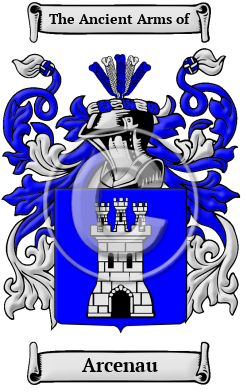
| ![Show Contents]() Arcenau History, Family Crest & Coats of Arms Arcenau History, Family Crest & Coats of Arms
- Origins Available:
France
Etymology of ArcenauWhat does the name Arcenau mean? The name Arcenau dates back to the times of Medieval France, in the region of Normandy. It is derived from their residence at Arcine, in the Canton of Haute-Savoie in Normandy. Early Origins of the Arcenau familyThe surname Arcenau was first found in Normandy (French: Normandie), the former Duchy of Normandy, where this ancient family has held a family seat since very early times. The first record of the name was in 1257 and 1264, and has a connection with the noble name of Von-Locarno. The period of the time when the family name was Arcenium was perhaps the most rewarding period in that during this time and up to July 1657 this family branch was elected to be the Barons Arcenale de Langon of Orleans and Poitou, but this branch became detached from the main stem of the name of Arsenault. The branch which spelt its name Arzegnio ultimately became Counts, but their history has disappeared into the mists of time. When the family arrived in North America it is thought to have first settled in the Canadian Maritimes in the late 1600's and the name became spelt with the traditional "lt" ending. The name flourished more during this period and until the 20th century, although the name is rarely found in the official records of the early French settlers. However, the name is still found in its original form of Arcegno (pronounced Arsenault) in Switzerland where many noble branches of the family exist. François Arseneau married Suzanne Lecomte in 1665. Suzanne died due to complications from childbirth after delivering their first son, Michel, on 24th December 1666. François died on 10th Februrary 1669 from influenza in Batiscan, Quebec. 1 Early History of the Arcenau familyThis web page shows only a small excerpt of our Arcenau research. Another 65 words (5 lines of text) covering the years 1347 and 1452 are included under the topic Early Arcenau History in all our PDF Extended History products and printed products wherever possible. Arcenau Spelling VariationsOne can encounter great variation in the spelling of French surnames; in part, as spelling, and the spelling names was not yet standardized during the early development of the written French language. Later, there was much branching and movement of families, and spellings would change according to region. Variations of the name Arcenau include Arsenault, Arsenaul, Arsenaulte, Arsenauld, Arsenaud, Arsenaut, Arsenot and many more. Early Notables of the Arcenau familyMore information is included under the topic Early Arcenau Notables in all our PDF Extended History products and printed products wherever possible. Migration of the Arcenau familyFrance finally gave land incentives for 2,000 migrants during the 1700s. Early marriage was encouraged in New France, and youths of 18 took fourteen-year-old girls for their wives. The fur trade was developed and attracted migrants, both noble and commoner from France. 15,000 explorers left Montreal in the late 17th and 18th centuries, leaving French names scattered across the continent. The search for the Northwest passage continued. Migration from France to New France or Quebec, as it was now more popularly called, continued until 1759. By 1675, there were 7000 French in Quebec. By the same year the Acadian presence in Nova Scotia, New Brunswick and Prince Edward Island had reached 500. In the treaty of Utrecht, the Acadians were ceded by France to Britain in 1713. In 1755, 10,000 French Acadians refused to take an oath of allegiance to England and were deported. They found refuge in Louisiana. Meanwhile, in Quebec, the French race flourished, founding in Lower Canada, one of the two great solitudes which became Canada. Many of this distinguished family name Arcenau were prominent in social, cultural, religious and political affairs in France and New France. Amongst the settlers in North America with this distinguished name Arcenau were Pierre Arsenault (Pierre I) who was born in Rochefort in west-central France around 1646 and arrived in Acadia shortly after the 1671 census. In Acadia, Pierre I married twice and had 9 children. Pierre I, helped to found the Beaubassin settlement and several of Pierre I'.
- Olivier, Reginald L. Your Ancient Canadian Family Ties. Logan: The Everton Publishers, Inc., P.O. Box 368, 1972. Print
 |