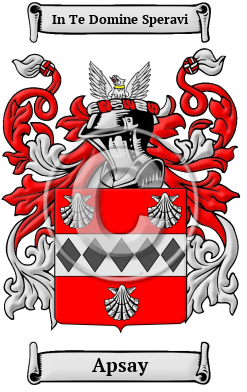
| ![Show Contents]() Apsay History, Family Crest & Coats of Arms Apsay History, Family Crest & Coats of Arms
- Origins Available:
England
Etymology of ApsayWhat does the name Apsay mean? The origins of the Apsay name lie with England's ancient Anglo-Saxon culture. It comes from when the family lived near one or more notable aspen trees. The surname Apsay is derived from the Old English word æpse, which means aspen. The surname may also be a nickname in jest, for a timid person, referring to the trembling leaves of the tree. 1 However, one source notes that name may be "a genitive form of Ape or Appe; a personal name, ante [(before)]1066 [and in the] Domesday Book. " 2 Early Origins of the Apsay familyThe surname Apsay was first found in Huntingdonshire where the singular name Eppe was recorded c. 1250. A few years later, Roger Eppe was listed in Norfolk according to the Hundredorum Rolls of 1275. The name could have originated at Epps Farm in Bentley, Warwickshire. 3 Early History of the Apsay familyThis web page shows only a small excerpt of our Apsay research. Another 185 words (13 lines of text) covering the years 1307, 1327, 1524, 1534, 1604, 1628, 1658, 1779, 1787, 1805, 1815, 1823, 1833, 1845, 1869 and 1874 are included under the topic Early Apsay History in all our PDF Extended History products and printed products wherever possible. Apsay Spelling VariationsBefore the last few hundred years, the English language had no fast system of spelling rules. For that reason, spelling variations are commonly found in early Anglo-Saxon surnames. Over the years, many variations of the name Apsay were recorded, including Apps, Apse, Abbs, Abb, App, Apsey, Epps, Ebbs, Epsey, Epp and many more. Early Notables of the Apsay familyMore information is included under the topic Early Apsay Notables in all our PDF Extended History products and printed products wherever possible. Migration of the Apsay familyTo escape oppression and starvation at that time, many English families left for the "open frontiers" of the New World with all its perceived opportunities. In droves people migrated to the many British colonies, those in North America in particular, paying high rates for passages in cramped, unsafe ships. Although many of the settlers did not make the long passage alive, those who did see the shores of North America perceived great opportunities before them. Many of the families that came from England went on to make essential contributions to the emerging nations of Canada and the United States. Research into various historical records revealed some of first members of the Apsay family emigrate to North America: Francis Eppes, who was on record in Virginia in 1625 with his three sons; Edward Abbs, who settled in Virginia in 1635; Edmond Apps who settled in Virginia in 1650.
The motto was originally a war cry or slogan. Mottoes first began to be shown with arms in the 14th and 15th centuries, but were not in general use until the 17th century. Thus the oldest coats of arms generally do not include a motto. Mottoes seldom form part of the grant of arms: Under most heraldic authorities, a motto is an optional component of the coat of arms, and can be added to or changed at will; many families have chosen not to display a motto.
Motto: In Te Domine Speravi
Motto Translation: In thee, O Lord, I have placed my hope.
- Bardsley, C.W, A Dictionary of English and Welsh Surnames: With Special American Instances. Wiltshire: Heraldry Today, 1901. Print. (ISBN 0-900455-44-6)
- Lower, Mark Anthony, Patronymica Britannica, A Dictionary of Family Names of the United Kingdom. London: John Russel Smith, 1860. Print.
- Reaney, P.H and R.M. Wilson, A Dictionary of English Surnames. London: Routledge, 1991. Print. (ISBN 0-415-05737-X)
 |