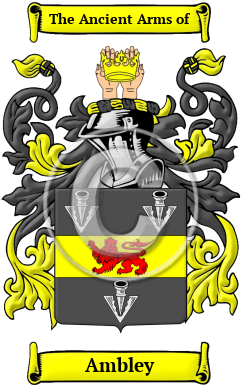
| ![Show Contents]() Ambley History, Family Crest & Coats of Arms Ambley History, Family Crest & Coats of Arms
- Origins Available:
England
Etymology of AmbleyWhat does the name Ambley mean? Ambley is a name of ancient Norman origin. It arrived in England with the Norman Conquest of 1066. It is a name for a person employed as an enameller, and derives from the Anglo-Norman-French amayler, of the same meaning. 1 It is also possible that the name refers to one who is employed in a profession which involves horses, as the Old English ambler means walker, and is a technical word for the slowest gait of a horse. 2 "The surname may mean ‘keeper of the stable’" 1 Their ancient estates were in Amblie, in Calvados in Normandy. 3 Early Origins of the Ambley familyThe surname Ambley was first found in Yorkshire where Nicholas le Aumbleour was recorded in 1307. Alexander Ambler was a Freeman of York in 1474. London records show William le Amayler there in 1303 and Robert Ambeler in 1375. Later, Simon le Amelous was listed in Somerset in 1344. 1 The Hundredorum Rolls of 1273 included Thomas le Amblur, but no county was provided. 4 "Ambler is an old Yorkshire name, now best represented in the West Riding, There were several of the name in Arnley about a century ago. William Ambler was mayor of Doucaster in 171, and one of the sheriffs of York in 1727 bore this name. In 1665, Captain Thomas Ambler gave £30 to the poor of Leeds. Ombler was the name of the mayor of Holderness, in the East Riding, in 1618, 1638, 1655, and 1821. The name occurred amongst the yeomen of East Hasterton in the reign of Edward VI. (D.); and going much further back we find Amblurs in the East Riding and in Lincolnshire in the reign of Edward I." 5 Early History of the Ambley familyThis web page shows only a small excerpt of our Ambley research. Another 122 words (9 lines of text) covering the years 1100, 1166 and 1924 are included under the topic Early Ambley History in all our PDF Extended History products and printed products wherever possible. Ambley Spelling VariationsA multitude of spelling variations characterize Norman surnames. Many variations occurred because Old and Middle English lacked any definite spelling rules. The introduction of Norman French to England also had a pronounced effect, as did the court languages of Latin and French. Therefore, one person was often referred to by several different spellings in a single lifetime. The various spellings include Ambler, Ambeller, Amblie, Anbler, Amble, Amblor and others. Early Notables of the Ambley familyMore information is included under the topic Early Ambley Notables in all our PDF Extended History products and printed products wherever possible. Migration of the Ambley familyMany English families left England, to avoid the chaos of their homeland and migrated to the many British colonies abroad. Although the conditions on the ships were extremely cramped, and some travelers arrived diseased, starving, and destitute, once in the colonies, many of the families prospered and made valuable contributions to the cultures of what would become the United States and Canada. Research into the origins of individual families in North America has revealed records of the immigration of a number of people bearing the name Ambley or a variant listed above: Martha Ambler who settled in Virginia in 1721; John Ambler settled in Virginia in 1721; Benjamin in New York State, in 1774; with his wife, Mary, son John, and Ann, his daughter..
- Reaney, P.H and R.M. Wilson, A Dictionary of English Surnames. London: Routledge, 1991. Print. (ISBN 0-415-05737-X)
- Harrison, Henry, Surnames of the United Kingdom: A Concise Etymological Dictionary Baltimore: Geneological Publishing Company, 2013. Print
- The Norman People and Their Existing Descendants in the British Dominions and the United States Of America. Baltimore: Genealogical Publishing, 1975. Print. (ISBN 0-8063-0636-X)
- Bardsley, C.W, A Dictionary of English and Welsh Surnames: With Special American Instances. Wiltshire: Heraldry Today, 1901. Print. (ISBN 0-900455-44-6)
- Guppy, Henry Brougham, Homes of Family Names in Great Britain. 1890. Print.
 |