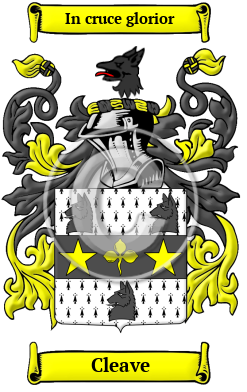
| ![Show Contents]() Cleave History, Family Crest & Coats of Arms Cleave History, Family Crest & Coats of Arms
Etymology of CleaveWhat does the name Cleave mean? The surname Cleave is derived from the Old English word "clif," which means cliff, rock, or steep descent. It is thought to have been a name used for someone who lived near a sloping cliff or the bank of a river. As such, the surname Cleave belongs to the class of topographic surnames, which were given to people who resided near physical features such as hills, streams, churches, or types of trees. Early Origins of the Cleave familyThe surname Cleave was first found in Shropshire and Cheshire. The latter county "in the hundred of Northwich, is Clive, from whence their ancestor Warin assumed his name in the time of Henry II. About the reign of Edward II the family removed to Huxley, also in Cheshire, Henry de Clive having married the co-heiress. " 1 The Shropshire branch claim descent from the village and civil parish so named. "James Clive with the heiress of Styche, of Styche, they settled in Shropshire at that place, which is in the parish of Moreton-Say, and has remained uninterruptedly in the Clive family." 1 Henry de Cliff (d. 1334), the English judge, "is first mentioned as accompanying the king abroad in May 1313; and on 11 May 1317, as a master in chancery, he had charge of the great seal at the house of the Lord Chancellor, John de Sandale, Bishop of Winchester. There is another master in chancery in Edward II's reign of the same name, probably a brother. " 2 Early History of the Cleave familyThis web page shows only a small excerpt of our Cleave research. Another 138 words (10 lines of text) covering the years 1514, 1522, 1523, 1526, 1529, 1532, 1558, 1711, 1725, 1728, 1729, 1731, 1734, 1767 and 1774 are included under the topic Early Cleave History in all our PDF Extended History products and printed products wherever possible. Cleave Spelling VariationsThere are relatively few surnames native to Wales, but they have an inordinately large number of spelling variations. Early variations of Welsh surnames can be explained by the fact that very few people in the early Middle Ages were literate. Priests and the few other literate people were responsible for recording names in official documents. And because most people could not specific how to properly record their names it was up to the individual recorder of that time to determine how a spoken name should be recorded. Variations due to the imprecise or improper recording of a name continued later in history when names originally composed in the Brythonic Celtic, language of Wales, known by natives as Cymraeg, were transliterated into English. Welsh names that were documented in English often changed dramatically since the native language of Wales, which was highly inflected, did not copy well. Occasionally, however, spelling variations were carried out according to an individual's specific design: a branch loyalty within the family, a religious adherence, or even patriotic affiliations could be indicated by minor variations. The spelling variations of the name Cleave have included Cliffe, Cliff, Clive, Cleeves, Cleave, Cleaves and many more. Early Notables of the Cleave familyWilliam Clyffe (d. 1558), English divine, educated at Cambridge, where he graduated LL.B. in 1514, was admitted advocate at Doctors' Commons on 16 Dec. 1522, graduated LL.D. in 1523, was commissary of the diocese of London between 1522 and 1529. In 1526, he was appointed Archdeacon of London and three years later, Prebendary of Fenton in the church of York in 1532. 2
Catherine Clive, daughter of William Raftor, an Irish gentleman, was born in London in 1711. Displaying a natural aptitude for the stage she was engaged by Colley Cibber for Drury...
Another 92 words (7 lines of text) are included under the topic Early Cleave Notables in all our PDF Extended History products and printed products wherever possible.
| Cleave migration to the United States | + |
North America in the 1800s and 1900s saw the arrival of many Welsh people hoping to share in the wealth of land, work, and freedom that they felt North America held. Those who made the journey often attained those expectations, but only through an enormous amount of hard work, perseverance, and often a bout of good luck. These immigrants helped contribute to the growth of industry, commerce, and culture of both Canada and the United States. Discovered in the immigration and passenger lists were a number of people bearing the name Cleave:
Cleave Settlers in United States in the 17th Century- Nathaniel Cleave, who arrived in Maryland in 1659 3
- Francis Cleave, who landed in Maryland in 1660 3
- John Cleave, who landed in Maryland in 1679 3
Cleave Settlers in United States in the 19th Century- Charles Cleave, who landed in New York, NY in 1826 3
Cleave Settlers in United States in the 20th Century- Mr. Richard Cleave, (b. 1881), aged 19, Cornish carrier travelling aboard the ship "Lucania" arriving at Ellis Island, New York on 31st March 1900 en route to Chicago, Illinois, USA 4
- Mr. Alfred Cleave, (b. 1884), aged 20, American farmer travelling aboard the ship "St Paul" arriving at Ellis Island, New York on 8th May 1904 en route to Rochester, Indiana, USA 4
- Miss Nellie Cleave, (b. 1884), aged 20, American dressmaker travelling aboard the ship "St Paul" arriving at Ellis Island, New York on 8th May 1904 en route to Rochester, Indiana, USA 4
| Cleave migration to Canada | + |
Cleave Settlers in Canada in the 20th Century- W H Cleave, who arrived in Saint John, New Brunswick in 1907
| Cleave migration to Australia | + |
Cleave Settlers in Australia in the 19th Century- Mr. William Cleave, English convict who was convicted in Dover, Kent, England for 7 years, transported aboard the "Earl Grey" on 27th July 1838, arriving in New South Wales, Australia 5
- Mary Cleave, who arrived in Adelaide, Australia aboard the ship "Success" in 1848 6
- William Cleave, aged 24, a labourer, who arrived in South Australia in 1851 aboard the ship "Osceola" 7
- Mr. Edmund Cleave, (b. 1824), aged 29, Cornish mason, from Egloshayle, Cornwall, UK travelling aboard the ship "Malvina Vidal" arriving in New South Wales, Australia on 20th June 1853 8
- Mrs. Martha Cleave, (b. 1827), aged 26, English settler, from Devonport, Devonshire, England, UK travelling aboard the ship "Malvina Vidal" arriving in New South Wales, Australia on 20th June 1853 8
- ... (More are available in all our PDF Extended History products and printed products wherever possible.)
| Cleave migration to New Zealand | + |
Emigration to New Zealand followed in the footsteps of the European explorers, such as Captain Cook (1769-70): first came sealers, whalers, missionaries, and traders. By 1838, the British New Zealand Company had begun buying land from the Maori tribes, and selling it to settlers, and, after the Treaty of Waitangi in 1840, many British families set out on the arduous six month journey from Britain to Aotearoa to start a new life. Early immigrants include: Cleave Settlers in New Zealand in the 19th Century- William Henry Cleave, aged 16, a labourer, who arrived in Auckland, New Zealand aboard the ship "Dunedin" in 1875 9
- Elizabeth Cleave, aged 16, a nurse, who arrived in Auckland, New Zealand aboard the ship "Dunedin" in 1875 9
- Robert S. Cleave, aged 20, a farm labourer, who arrived in Auckland, New Zealand aboard the ship "Maraval" in 1879
- William Cleave, aged 16, a farm labourer, who arrived in Auckland, New Zealand aboard the ship "Maraval" in 1879
- Mr. Robert S. Cleave, (b. 1858), aged 20, Cornish farm labourer departing on 15th October 1878 aboard the ship "Maraval" arriving in Auckland, New Zealand on 17th January 1879 10
- ... (More are available in all our PDF Extended History products and printed products wherever possible.)
| Contemporary Notables of the name Cleave (post 1700) | + |
- Nathan Lang Van Cleave (1910-1970), American composer and orchestrator for film, television, and radio
- Mary L. Cleave PH.D., P.E. (b. 1947), former NASA Astronaut with over 10 days in space 11
- O. E. Van Cleave, American Democratic Party politician, Delegate to Democratic National Convention from Tennessee, 1936 12
- J. S. M. Van Cleave, American politician, U.S. Attorney for Washington, 1859-60 13
- Dorn E. III Van Cleave, American Libertarian politician, Candidate for U.S. Representative from Illinois 7th District, 1998 13
- A. J. Van Cleave, American Democratic Party politician, Member of Missouri State House of Representatives from Henry County, 1923-24 13
- Maureen Cleave (1934-2021), British journalist who worked for the London Evening Standard from the 1960s and interviewed many prominent musicians of the era, including Bob Dylan and John Lennon
- Tom Cleave Stott CBE (1899-1976), Australian politician, an independent member of the South Australian House of Assembly, Speaker of the House from 1962 to 1965 and 1968 to 1970
| Historic Events for the Cleave family | + |
SS Gothenburg - Mr. Edward Cleave, Australian passenger who died aboard the ship "SS Gothenburg" when she sank on the 24th February 1875
The motto was originally a war cry or slogan. Mottoes first began to be shown with arms in the 14th and 15th centuries, but were not in general use until the 17th century. Thus the oldest coats of arms generally do not include a motto. Mottoes seldom form part of the grant of arms: Under most heraldic authorities, a motto is an optional component of the coat of arms, and can be added to or changed at will; many families have chosen not to display a motto.
Motto: In cruce glorior
Motto Translation: I glory in the cross.
- Shirley, Evelyn Philip, The Noble and Gentle Men of England; The Arms and Descents. Westminster: John Bower Nichols and Sons, 1866, Print.
- Smith, George (ed), Dictionary of National Biography. London: Smith, Elder & Co., 1885-1900. Print
- Filby, P. William, Meyer, Mary K., Passenger and immigration lists index : a guide to published arrival records of about 500,000 passengers who came to the United States and Canada in the seventeenth, eighteenth, and nineteenth centuries. 1982-1985 Cumulated Supplements in Four Volumes Detroit, Mich. : Gale Research Co., 1985, Print (ISBN 0-8103-1795-8)
- Cornwall Online Parish Clerks. (Retrieved 3rd May 2018). Retrieved from http://www.opc-cornwall.org/Resc/pdfs/emigration_ellis_island_1892_on.pdf
- Convict Records Voyages to Australia (Retrieved 17th August 2021). Retrieved from https://convictrecords.com.au/ships/earl-grey
- State Records of South Australia. (Retrieved 2010, November 5) SUCCESS 1848. Retrieved from http://www.slsa.sa.gov.au/BSA/1848Success.htm
- State Records of South Australia. (Retrieved 2010, November 5) OSCEOLA / ASCEOLA 1851. Retrieved http://www.slsa.sa.gov.au/BSA/1851Osceola-Asceola.htm
- Cornwall Online Parish Clerks. (Retrieved 3rd May 2018). Retrieved from http://www.opc-cornwall.org/Resc/pdfs/emigration_1850_59.pdf
- New Zealand Yesteryears Passenger Lists 1800 to 1900 (Retrieved 9th November 2011). Retrieved from http://www.yesteryears.co.nz/shipping/passlist.html
- Cornwall Online Parish Clerks. (Retrieved 2018, April 30). Emigrants to Auckland 1872-80 [PDF]. Retrieved from http://www.opc-cornwall.org/Resc/pdfs/new_zealand_assisted.pdf
- NASA Astronauts Homepage. (Retrieved 2010, September 27) Mary Cleave. Retrieved from http://www.jsc.nasa.gov/Bios/htmlbios/cleave-ml.html
- The Political Graveyard: Alphabetical Name Index. (Retrieved 2016, February 2) . Retrieved from http://politicalgraveyard.com/alpha/index.html
 |