
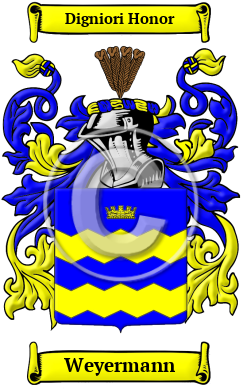
Show ContentsWeyermann History, Family Crest & Coats of Arms

Early Origins of the Weyermann family

The surname Weyermann was first found in Holland, where the name became noted for its many branches in the region, each house acquiring a status and influence which was envied by the princes of the region. The name was first recorded in Amsterdam, an ancient 13th century town held by the Lords of Amstel. Giesebrecht II built a castle there. Geisbrecht III built the dam to keep out the sea. It is first mentioned in charters of 1275 when Floris IV, the count of Holland granted its charter. It became a city of great mercantile wealth. It hold great treasures of art. The name was one of the founding families of this great city. In their later history the surname became a power unto themselves and were elevated to the ranks of nobility as they grew into a most influential family.

Early History of the Weyermann family

This web page shows only a small excerpt of our Weyermann research. Another 67 words (5 lines of text) are included under the topic Early Weyermann History in all our PDF Extended History products and printed products wherever possible.

Weyermann Spelling Variations

Spelling variations of this family name include: Weyerman, ven de Weyer, van den Weyer, Weyer and others.

Early Notables of the Weyermann family

More information is included under the topic Early Weyermann Notables in all our PDF Extended History products and printed products wherever possible.


Weyermann migration to the United States +


Weyermann Settlers in United States in the 18th Century
  • Anna Weyermann, who sailed for America in 1727
Weyermann Settlers in United States in the 19th Century
  • Gottfried Weyermann, who landed in Colorado in 1884 1

Contemporary Notables of the name Weyermann (post 1700) +

  • Diane Hope Weyermann (1955-2021), American filmmaker who was the chief content officer for the film and television production company Participant Media
  • Anita Weyermann, Swiss track athlete


The Weyermann Motto +

The motto was originally a war cry or slogan. Mottoes first began to be shown with arms in the 14th and 15th centuries, but were not in general use until the 17th century. Thus the oldest coats of arms generally do not include a motto. Mottoes seldom form part of the grant of arms: Under most heraldic authorities, a motto is an optional component of the coat of arms, and can be added to or changed at will; many families have chosen not to display a motto.

Motto: Digniori Honor
Motto Translation: God and my country


  1. Filby, P. William, Meyer, Mary K., Passenger and immigration lists index : a guide to published arrival records of about 500,000 passengers who came to the United States and Canada in the seventeenth, eighteenth, and nineteenth centuries. 1982-1985 Cumulated Supplements in Four Volumes Detroit, Mich. : Gale Research Co., 1985, Print (ISBN 0-8103-1795-8)


Houseofnames.com on Facebook