| ![Show Contents]() Webert History, Family Crest & Coats of Arms Webert History, Family Crest & Coats of Arms
- Origins Available:
Germany
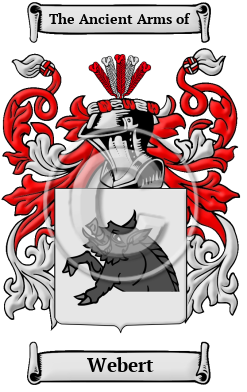
Etymology of WebertWhat does the name Webert mean? The Webert family name first began to be used in the German state of Bavaria. After the 12th century, hereditary surnames were adopted according to fairly general rules, and names that were derived from locations became particularly common. The family name Webert is a local surname. Originally denoting the proprietorship of an estate or influence within a village, the German preposition von, which means from or of, used with local names, was taken as a mark of aristocracy. The surname Webert was given to someone who lived in Bavaria, where, although born of humble stock, the family soon rose to prominence on the strength of their contributions to the emerging medieval cultural life of the province. The surname Webert was a nickname, and came from the German word eber, which means boar. This family was probably originally associated with the hunting or breeding of boars. Early Origins of the Webert familyThe surname Webert was first found in Bavaria, where the name came from humble beginnings but gained a significant reputation for its contribution to the emerging mediaeval society. It later became more prominent as many branches of the same house acquired distant estates and branches, some in foreign countries, always elevating their social status by their great contributions to society. Early History of the Webert familyThis web page shows only a small excerpt of our Webert research. Another 115 words (8 lines of text) covering the years 1791 and 1834 are included under the topic Early Webert History in all our PDF Extended History products and printed products wherever possible. Webert Spelling VariationsIn the medieval era, many different cultural groups lived in the German states. There are thus many regional variations of German surnames from that era. Westphalians spoke Low German, which is similar to modern Dutch. Many German names carry suffixes that identify where they came from. Others have phrases attached that identify something about the original bearer. Other variations in German names resulted from the fact that medieval scribes worked without the aid of any spelling rules. The spelling variations of the name Webert include Ebert, Ebbert, Ebart, Ebbart, Ebartz, Ebbartz and others. Early Notables of the Webert familyMore information is included under the topic Early Webert Notables in all our PDF Extended History products and printed products wherever possible.
| Webert migration to the United States | + |
The great European flow of migration to North America, which began in the middle of the 17th century and continued into the 20th century, was particularly attractive to those from Bavaria who wished to escape either poverty or religious persecution. For many Bavarian tenant farmers, the chance to own their own land was a major incentive. So the widespread colonization of the United States began in 1650, when many immigrants from Germany settled in pockets in Pennsylvania, Texas, New York, Illinois, and California. In Canada, German settlement centered in Ontario and the prairie provinces. Among those of this surname listed in various historical records were:
Webert Settlers in United States in the 18th Century- Bernhart Webert, who landed in Pennsylvania in 1773 1
Webert Settlers in United States in the 20th Century- Francis J Webert, who arrived in Arkansas in 1904 1
| Contemporary Notables of the name Webert (post 1700) | + |
- Michael J. Webert (1979-2012), American politician, Member of the Virginia House of Delegates (2012-)
- Filby, P. William, Meyer, Mary K., Passenger and immigration lists index : a guide to published arrival records of about 500,000 passengers who came to the United States and Canada in the seventeenth, eighteenth, and nineteenth centuries. 1982-1985 Cumulated Supplements in Four Volumes Detroit, Mich. : Gale Research Co., 1985, Print (ISBN 0-8103-1795-8)
 |