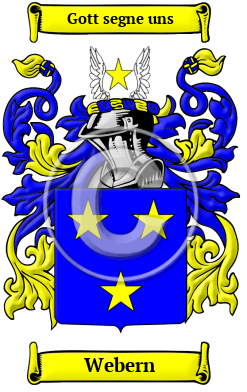
| ![Show Contents]() Webern History, Family Crest & Coats of Arms Webern History, Family Crest & Coats of Arms
- Origins Available:
Germany
Etymology of WebernWhat does the name Webern mean? The distinguished surname Webern was an occupational name derived from the Old Germanic word "weppi" which subsequently became "weban", meaning "to weave". Thus, Webern was a "weaver of cloth". Early Origins of the Webern familyThe surname Webern was first found in Saxony, where the name was closely associated in the mediaeval period with the feudal society that would become prominent throughout European history. The name enjoys a much longer history in the old German Empire with one of the earliest written records dating to 1290 when one Heinricus dictus Weber was registered as living in Basel. (Zeitschrift fur die Geschichte des Oberrheins) and Uoli Waeber who lived in Waldkirch (Urkundenbuch der Abtei St. Gallen) Early History of the Webern familyThis web page shows only a small excerpt of our Webern research. Another 185 words (13 lines of text) covering the years 1622, 1766, 1779, 1786, 1795, 1804, 1811, 1826, 1839, 1842, 1862, 1878 and 1891 are included under the topic Early Webern History in all our PDF Extended History products and printed products wherever possible. Webern Spelling VariationsSpelling variations of this family name include: Weber, Webber, Webere, Weberer, Waeber, Weyber, Webern, Weeber, Weiber, Wieber and many more. Early Notables of the Webern familyErnst Heinrich Weber (1795-1878), anatomist and physiologist, who is known for his path finding research on sensation. His brother, Wilhelm Weber (1804-1891), played a major role in constructing the first electronic telegraph. Constanze Weber, daughter of a prominent musical family of Webers in Mannheim...
Another 43 words (3 lines of text) are included under the topic Early Webern Notables in all our PDF Extended History products and printed products wherever possible.
| Webern migration to the United States | + |
Webern Settlers in United States in the 18th Century- Gerdradt Webern, who arrived in Pennsylvania in 1732 1
- Henrick Webern, who landed in Pennsylvania in 1732 1
- Lawrence Webern, who arrived in Pennsylvania in 1732 1
Webern Settlers in United States in the 19th Century- Maria Gertde Webern, who landed in Pennsylvania in 1803 1
- Anna Webern, who landed in Philadelphia, Pennsylvania in 1808 1
The motto was originally a war cry or slogan. Mottoes first began to be shown with arms in the 14th and 15th centuries, but were not in general use until the 17th century. Thus the oldest coats of arms generally do not include a motto. Mottoes seldom form part of the grant of arms: Under most heraldic authorities, a motto is an optional component of the coat of arms, and can be added to or changed at will; many families have chosen not to display a motto.
Motto: Gott segne uns
Motto Translation: God bless us
- Filby, P. William, Meyer, Mary K., Passenger and immigration lists index : a guide to published arrival records of about 500,000 passengers who came to the United States and Canada in the seventeenth, eighteenth, and nineteenth centuries. 1982-1985 Cumulated Supplements in Four Volumes Detroit, Mich. : Gale Research Co., 1985, Print (ISBN 0-8103-1795-8)
 |