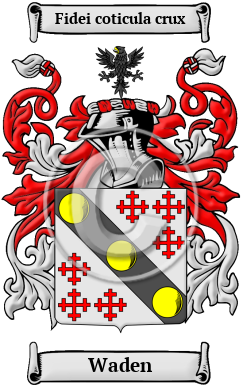
| ![Show Contents]() Waden History, Family Crest & Coats of Arms Waden History, Family Crest & Coats of Arms
- Origins Available:
England
Etymology of WadenWhat does the name Waden mean? Waden is a name of ancient Norman origin. It arrived in England with the Norman Conquest of 1066. The Waden family lived in Nottingham, at Whatton. The name of this town derives from the Old English words hvaete, meaning wheat, and tun, meaning settlement or enclosure. 1 Early Origins of the Waden familyThe surname Waden was first found in Nottingham where a Norman noble, Robert de Watone, the youngest son of Gaitier de Tirell, Seigneur de Poix in Picardy, was granted the Lordship of Wattone in the Vale in that shire, and it was shown in the Domesday Survey of 1086. 2 Today, there are numerous places in Britain by the name Watton: Watton, Devon; Watton, East Riding of Yorkshire; Watton, Norfolk; and Watton-at-Stone, Hertfordshire. Early History of the Waden familyThis web page shows only a small excerpt of our Waden research. Another 121 words (9 lines of text) are included under the topic Early Waden History in all our PDF Extended History products and printed products wherever possible. Waden Spelling VariationsMultitudes of spelling variations are a hallmark of Anglo Norman names. Most of these names evolved in the 11th and 12th century, in the time after the Normans introduced their own Norman French language into a country where Old and Middle English had no spelling rules and the languages of the court were French and Latin. To make matters worse, medieval scribes spelled words according to sound, so names frequently appeared differently in the various documents in which they were recorded. The name was spelled Wattone, Watone, Wathon, Watton, Watten, Wattan, Whattone, Whatone, Whathon and many more. Early Notables of the Waden familyMore information is included under the topic Early Waden Notables in all our PDF Extended History products and printed products wherever possible.
| Waden migration to New Zealand | + |
Emigration to New Zealand followed in the footsteps of the European explorers, such as Captain Cook (1769-70): first came sealers, whalers, missionaries, and traders. By 1838, the British New Zealand Company had begun buying land from the Maori tribes, and selling it to settlers, and, after the Treaty of Waitangi in 1840, many British families set out on the arduous six month journey from Britain to Aotearoa to start a new life. Early immigrants include: Waden Settlers in New Zealand in the 19th Century- Mr. George Waden, (b. 1813), aged 40, British settler travelling from London aboard the ship "Egmont" arriving in Lyttelton, Canterbury, New Zealand on 23rd December 1853 3
- Mrs. Alison Waden, (b. 1814), aged 39, British settler travelling from London aboard the ship "Egmont" arriving in Lyttelton, Canterbury, New Zealand on 23rd December 1853 3
- Miss Christina Waden, (b. 1833), aged 20, British settler travelling from London aboard the ship "Egmont" arriving in Lyttelton, Canterbury, New Zealand on 23rd December 1853 3
- Miss Jane Waden, (b. 1836), aged 17, British settler travelling from London aboard the ship "Egmont" arriving in Lyttelton, Canterbury, New Zealand on 23rd December 1853 3
- Miss Alison Waden, (b. 1838), aged 15, British settler travelling from London aboard the ship "Egmont" arriving in Lyttelton, Canterbury, New Zealand on 23rd December 1853 3
- ... (More are available in all our PDF Extended History products and printed products wherever possible.)
The motto was originally a war cry or slogan. Mottoes first began to be shown with arms in the 14th and 15th centuries, but were not in general use until the 17th century. Thus the oldest coats of arms generally do not include a motto. Mottoes seldom form part of the grant of arms: Under most heraldic authorities, a motto is an optional component of the coat of arms, and can be added to or changed at will; many families have chosen not to display a motto.
Motto: Fidei coticula crux
Motto Translation: The cross is the test of truth.
- Mills, A.D., Dictionary of English Place-Names. Oxford: Oxford University Press, 1991. Print. (ISBN 0-19-869156-4)
- The Norman People and Their Existing Descendants in the British Dominions and the United States Of America. Baltimore: Genealogical Publishing, 1975. Print. (ISBN 0-8063-0636-X)
- New Zealand Yesteryears Passenger Lists 1800 to 1900 (Retrieved 17th October 2018). Retrieved from http://www.yesteryears.co.nz/shipping/passlist.html
 |