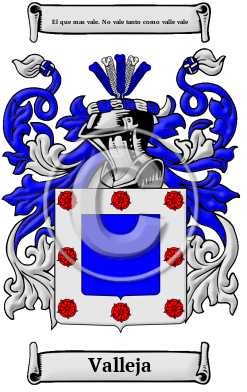
The original bearer of the name Valleja, which is a local surname, once lived, held land, or was born in the beautiful region of Spain. In Spain, hereditary surnames were adopted according to fairly general rules. Local names originally denoted the proprietorship of the village or estate. The Valleja family lived near a valley. There is also a place-name Valle in Santander, which is in northern Spain. The place-name is derived form the Spanish word valle, the English valley and the French vallee, which all derive from the Latin word vallis.
Loading...
Early Origins of the Valleja family
The surname Valleja was first found in Castile, in north central Spain.
Early History of the Valleja family
This web page shows only a small excerpt of our Valleja research. Another 70 words (5 lines of text) covering the year 1191 is included under the topic Early Valleja History in all our PDF Extended History products and printed products wherever possible.
Valleja Spelling Variations
Spelling variations of this family name include: Valle, del Valle, Vallés, Valles, de Valles, Vallecillo, Vallejo, de Vallejo, Vallejos and many more.
Early Notables of the Valleja family
were sixteenth century doctor Francisco Vallés, physician to King Philip II; seventeenth century Spanish actress María Antonia Vallejo Fernández; seventeenth century Peruvian poet Juan del Valle y Caviedes; eighteenth century Spanish politician and diplomat Antonio Valle Hernández; nineteenth century Guatemalan writer José Cecilio del Valle; nineteenth century Argentinian painter Angel del Valle; nineteenth... Another 53 words (4 lines of text) are included under the topic Early Valleja Notables in all our PDF Extended History products and printed products wherever possible.
Loading...
Loading...
Loading...
Loading...
Migration of the Valleja family
Some of the first settlers of this family name or some of its variants were: Pedro Vallejo, who voyaged to Mexico with the expedition of Hernán Cortés in 1519. Other early migrants to the New World included Alonso del Valle, who sailed to America in 1509.
The motto was originally a war cry or slogan. Mottoes first began to be shown with arms in the 14th and 15th centuries, but were not in general use until the 17th century. Thus the oldest coats of arms generally do not include a motto. Mottoes seldom form part of the grant of arms: Under most heraldic authorities, a motto is an optional component of the coat of arms, and can be added to or changed at will; many families have chosen not to display a motto.
Motto: El que mas vale. No vale tanto como valle vale
Remove Item
WARNING!
Removing this item from your shopping cart will remove your associated sale items.
Are you sure you want to delete this item from your shopping cart?