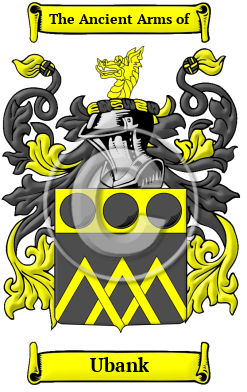
| ![Show Contents]() Ubank History, Family Crest & Coats of Arms Ubank History, Family Crest & Coats of Arms
- Origins Available:
England
Etymology of UbankWhat does the name Ubank mean? This "surname is derived from a geographical locality, 'of the yew-bank,' from residence on the bank where the yew-trees grew." 1 Specifically, the family claim descent from "Yewbank, a location name in Cumberland." 2 3 Early Origins of the Ubank familyThe surname Ubank was first found in Cumberland where Waldef de Yuebanc was recorded c. 1258. In nearby Yorkshire, William Hughbank was listed as a Freeman of York in 1464, Robert Hewbank was recorded in 1475 and Oswald Ewbanke was listed as a Freeman of York in 1592. 3 Early History of the Ubank familyThis web page shows only a small excerpt of our Ubank research. Another 67 words (5 lines of text) covering the years 1792, 1799, 1812, 1813, 1819, 1836, 1845, 1847, 1849, 1856 and 1870 are included under the topic Early Ubank History in all our PDF Extended History products and printed products wherever possible. Ubank Spelling VariationsSpelling variations of this family name include: Ewbank, Ewbanke, Ewbanks, Eubank, Ewbanck and others. Early Notables of the Ubank familyJohn Ewbank (1799?-1847), English painter, born at Gateshead, Durham, in or about 1799 and was adopted when a child by a wealthy uncle who lived at Wycliffe, on the banks of the Tees, Yorkshire. Being designed for the Roman Catholic priesthood, he was sent to Ushaw College, from which he absconded, and in 1813 bound himself apprentice to T. Coulson, an ornamental painter in Newcastle. So strong had become his love for art that on removing with his master to Edinburgh, he was allowed to study under Alexander Nasmyth. His talents soon procured him practice both as a painter and a...
Another 140 words (10 lines of text) are included under the topic Early Ubank Notables in all our PDF Extended History products and printed products wherever possible.
| Ubank migration to West Indies | + |
The British first settled the British West Indies around 1604. They made many attempts but failed in some to establish settlements on the Islands including Saint Lucia and Grenada. By 1627 they had managed to establish settlements on St. Kitts (St. Christopher) and Barbados, but by 1641 the Spanish had moved in and destroyed some of these including those at Providence Island. The British continued to expand the settlements including setting the First Federation in the British West Indies by 1674; some of the islands include Barbados, Bermuda, Cayman Island, Turks and Caicos, Jamaica and Belize then known as British Honduras. By the 1960's many of the islands became independent after the West Indies Federation which existed from 1958 to 1962 failed due to internal political conflicts. After this a number of Eastern Caribbean islands formed a free association. 4Ubank Settlers in West Indies in the 17th Century- Mr. William Ubank, aged 20 who arrived in St. Kitts (St Christopher) aboard the ship "Amity" in 1635 5
- Bardsley, C.W, A Dictionary of English and Welsh Surnames: With Special American Instances. Wiltshire: Heraldry Today, 1901. Print. (ISBN 0-900455-44-6)
- Barber, Henry, British Family Names London: Elliot Stock, 62 Paternoster Row, 1894. Print.
- Reaney, P.H and R.M. Wilson, A Dictionary of English Surnames. London: Routledge, 1991. Print. (ISBN 0-415-05737-X)
- https://en.wikipedia.org/wiki/British_West_Indies
- Filby, P. William, Meyer, Mary K., Passenger and immigration lists index : a guide to published arrival records of about 500,000 passengers who came to the United States and Canada in the seventeenth, eighteenth, and nineteenth centuries. 1982-1985 Cumulated Supplements in Four Volumes Detroit, Mich. : Gale Research Co., 1985, Print (ISBN 0-8103-1795-8)
 |