| ![Show Contents]() Tuchner History, Family Crest & Coats of Arms Tuchner History, Family Crest & Coats of Arms
- Origins Available:
Germany
Etymology of TuchnerWhat does the name Tuchner mean? The ancient roots of the Tuchner family are found in the German state of Bavaria. Tuchner was a local name, for someone who lived in Nuremberg. Early Origins of the Tuchner familyThe surname Tuchner was first found in Nuremberg, where the name was closely identified in early mediaeval times with the feudal society which would become prominent throughout European history. The name would later emerge as a noble family with great influence, having many distinguished branches, and become noted for its involvement in social, economic and political affairs. Founded in 1050, Nuremberg was one of the main cities of Franconia, before its annexation by Bavaria in 1806. It became a major center of exchange for goods coming south from the Baltic ports, and products moving north from the Mediterranean. Frederick II named Nuremberg a Free Imperial City in the 13th century, and during this period of economic prosperity it became a center of the Arts. It was the birthplace of the poet Hans Sachs and the painter Albrecht Duerer. Early History of the Tuchner familyThis web page shows only a small excerpt of our Tuchner research. Another 194 words (14 lines of text) covering the years 1310, 1332, 1349, 1363, 1794 and 1815 are included under the topic Early Tuchner History in all our PDF Extended History products and printed products wherever possible. Tuchner Spelling VariationsMany cultural groups lived in the German states in medieval times. Each had its own dialect and traditions, and unique variations of popular names. Low German, which is similar to contemporary Dutch, was spoken in Westphalia. German names are characterized by additions such as regional suffixes and phrases that tell something about the origin or background of its original bearer. Further contributing to the variation in German names was the fact that there were no spelling rules in medieval times: scribes recorded names according to their sound. The recorded spelling variations of Tuchner include Tucher, Tuchert, Tucherer, Tuecher, Tuecherer, Tuchner, Tuche, Tueche, Tuocher and many more. Early Notables of the Tuchner familyMore information is included under the topic Early Tuchner Notables in all our PDF Extended History products and printed products wherever possible.
| Tuchner migration to the United States | + |
German settlers were among the most common to come to North America between the mid-17th and mid-20th centuries. Poverty and religious persecution drove many Bavarians to make this long trek. tenant farmers were also enticed by the prospect of owning land. From east to west, these German immigrants populated the United States, settling in Pennsylvania, Texas, New York, Illinois, and California. Ontario and the prairie provinces of Canada also provided homes to many. Early settlers bearing the Tuchner surname or a spelling variation of the name include:
Tuchner Settlers in United States in the 19th Century- Jacob Tuchner, who arrived in Philadelphia in 1843
The motto was originally a war cry or slogan. Mottoes first began to be shown with arms in the 14th and 15th centuries, but were not in general use until the 17th century. Thus the oldest coats of arms generally do not include a motto. Mottoes seldom form part of the grant of arms: Under most heraldic authorities, a motto is an optional component of the coat of arms, and can be added to or changed at will; many families have chosen not to display a motto.
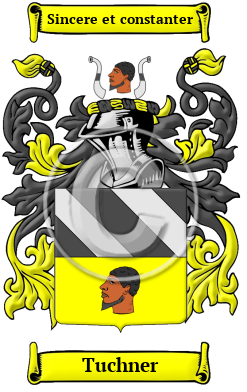
Motto: Sincere et constanter
Motto Translation: Sincerely and steadfastly.
 |