![Show Contents]() Trolup History, Family Crest & Coats of Arms Trolup History, Family Crest & Coats of Arms
- Origins Available:
England
Etymology of TrolupWhat does the name Trolup mean? The name Trolup is rooted in the ancient Norman culture that arrived in England after the Norman Conquest of England in 1066. It was a name for someone who was a person who derived their name from the Old Norse word "troll" meaning an "imp" or "super natural being" and the Old English word "hop" which means "enclosed valley." The most probable is that of the distinguished Lower, who suggests the name derives from Trois Loups, or 'three wolves' but then errs in ascribing a relationship to the many wolves which abounded in Lincolnshire. More likely it relates to the distinguished Coat of Arms of the Lupus family, the great Earls of Chester, who held extensive lands in Lincolnshire, and was conjecturally a junior branch of this royal family. The Lupus Coat of Arms was three wolves heads. 1 Early Origins of the Trolup familyThe surname Trolup was first found in Northumberland where the name was originally spelt Troughburn which was derived from the expression "troll-valley." Alternatively, the name could have been "derived from a geographical locality. 'of Trollop.' Probably 'hope' is the suffix. " 2 One of the first records of the family was William de Trollop in 1383 as listed in the Prior of Holy Island: Raine's History and Antiquities of North Durham. John Trolop was listed in 1401 in the History and Antiquities of the County Palatine of Durham. 2 Anthony Trollope (1815-1882), the famous English novelist of the Victorian era hailed from London but little is known of his lineage. Thomas Adolphus Trollope was his elder brother. Early History of the Trolup familyThis web page shows only a small excerpt of our Trolup research. Another 162 words (12 lines of text) covering the years 1298, 1320, 1461, 1564, 1640, 1756, 1815, 1839 and 1882 are included under the topic Early Trolup History in all our PDF Extended History products and printed products wherever possible. Trolup Spelling VariationsEndless spelling variations are a prevailing characteristic of Norman surnames. Old and Middle English lacked any definite spelling rules, and the introduction of Norman French added an unfamiliar ingredient to the English linguistic stew. French and Latin, the languages of the court, also influenced spellings. Finally, Medieval scribes generally spelled words according to how they sounded, so one person was often referred to by different spellings in different documents. The name has been spelled Trollop, Trollope and others. Early Notables of the Trolup familySir Andrew Trollope (d. 1461), the British soldier, "said by Waurin to have been of lowly origin. He fought long in the French wars of Henry VI's day, and acquired a great reputation for courage and skill...
Another 36 words (3 lines of text) are included under the topic Early Trolup Notables in all our PDF Extended History products and printed products wherever possible. Migration of the Trolup familyTo escape the political and religious persecution within England at the time, many English families left for the various British colonies abroad. The voyage was extremely difficult, though, and the cramped, dank ships caused many to arrive in the New World diseased and starving. But for those who made it, the trip was most often worth it. Many of the families who arrived went on to make valuable contributions to the emerging nations of Canada and the United States. An inquiry into the early roots of North American families reveals a number of immigrants bearing the name Trolup or a variant listed above: John Trollop settled in Virginia in 1642.
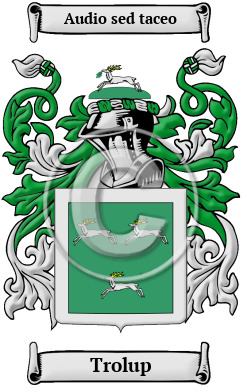
The motto was originally a war cry or slogan. Mottoes first began to be shown with arms in the 14th and 15th centuries, but were not in general use until the 17th century. Thus the oldest coats of arms generally do not include a motto. Mottoes seldom form part of the grant of arms: Under most heraldic authorities, a motto is an optional component of the coat of arms, and can be added to or changed at will; many families have chosen not to display a motto.
Motto: Audio sed taceo
Motto Translation: I hear, but say nothing.
- Lower, Mark Anthony, Patronymica Britannica, A Dictionary of Family Names of the United Kingdom. London: John Russel Smith, 1860. Print.
- Bardsley, C.W, A Dictionary of English and Welsh Surnames: With Special American Instances. Wiltshire: Heraldry Today, 1901. Print. (ISBN 0-900455-44-6)
 |