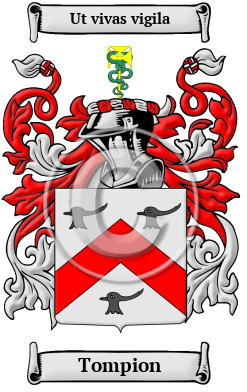
| ![Show Contents]() Tompion History, Family Crest & Coats of Arms Tompion History, Family Crest & Coats of Arms
- Origins Available:
England
Early Origins of the Tompion familyThe surname Tompion was first found in the North Riding of Yorkshire at Agelthorpe of Agglethorpe, a township, in the parish of Coverham, union of Leyburn, wapentake of Hang-West. "The monks of Coverham had land here, valued at £1. 6. 8. per annum; and the village, which is situated on the northern acclivity of the romantic Coverdale, is remarkable for its ancient Hall, now a farmhouse, which once belonged to the Topham family." 1 "Topsham [Devon] in all probability affords an instance of the preservation of a personal name from Saxon days, and is equivalent to ' Topa's ham.' In the sixteenth and seventeenth centuries it was frequently called Apsom. It is Topeshant in ' Domesday.' " 2 Early History of the Tompion familyThis web page shows only a small excerpt of our Tompion research. Another 83 words (6 lines of text) covering the years 1639, 1664, 1671, 1695, 1710, 1713, 1749, 1751 and 1820 are included under the topic Early Tompion History in all our PDF Extended History products and printed products wherever possible. Tompion Spelling VariationsSpelling variations of this family name include: Topham, Topam, Toppam and others. Early Notables of the Tompion family- Thomas Tompion (1639-1713), known as 'the father of English watchmaking,' is said to have been born at Northhill, Bedfordshire. "Tompion was apprenticed in 1664 to a London clockmaker, and was made fr...
Migration of the Tompion familySome of the first settlers of this family name or some of its variants were: Robert Topham who settled in Philadelphia, Pennsylvania in 1820 with a child; Richard Topham settled in Nova Scotia with his wife and child in 1774; Mr. and Mrs. Topham settled in Charles Town [Charleston], South Carolina in 1821..
| Contemporary Notables of the name Tompion (post 1700) | + |
- Thomas Tompion (1639-1713), English clockmaker
The motto was originally a war cry or slogan. Mottoes first began to be shown with arms in the 14th and 15th centuries, but were not in general use until the 17th century. Thus the oldest coats of arms generally do not include a motto. Mottoes seldom form part of the grant of arms: Under most heraldic authorities, a motto is an optional component of the coat of arms, and can be added to or changed at will; many families have chosen not to display a motto.
Motto: Ut vivas vigila
Motto Translation: Watch that you may live.
- Lewis, Samuel, A Topographical Dictionary of England. Institute of Historical Research, 1848, Print.
- Worth, R.N., A History of Devonshire London: Elliot Stock, 62, Paternoster Row, E.G., 1895. Digital
 |